Rubio Promises Cuba a Better Future — in a Cardboard Box
August 13, 2026
By Blake Burdge
"It's like heaven has opened up."
That's how Lázaro Nieto, 86, described receiving a U.S. government humanitarian aid kit that a Catholic charity recently delivered to his door in Bejucal, a small town outside of Havana.
Nieto, who lives on a pension of just over 3,000 Cuban pesos a month — less than $5 — was not alone in expressing his gratitude for the aid.
“It’s a tremendous help,” said Mariela Herrera, 57, a full-time caretaker of her disabled mother. “Food is very expensive. This gives us some peace of mind, even if it’s only for a little while.”
Facing an unprecedented humanitarian crisis, Cuba has welcomed millions of dollars in donations from governments around the world, including Vietnam, Mexico, China, Canada and Spain. But there is a stark contradiction at the heart of the U.S. aid effort: Washington is offering relief from a crisis its own policies have brought about.
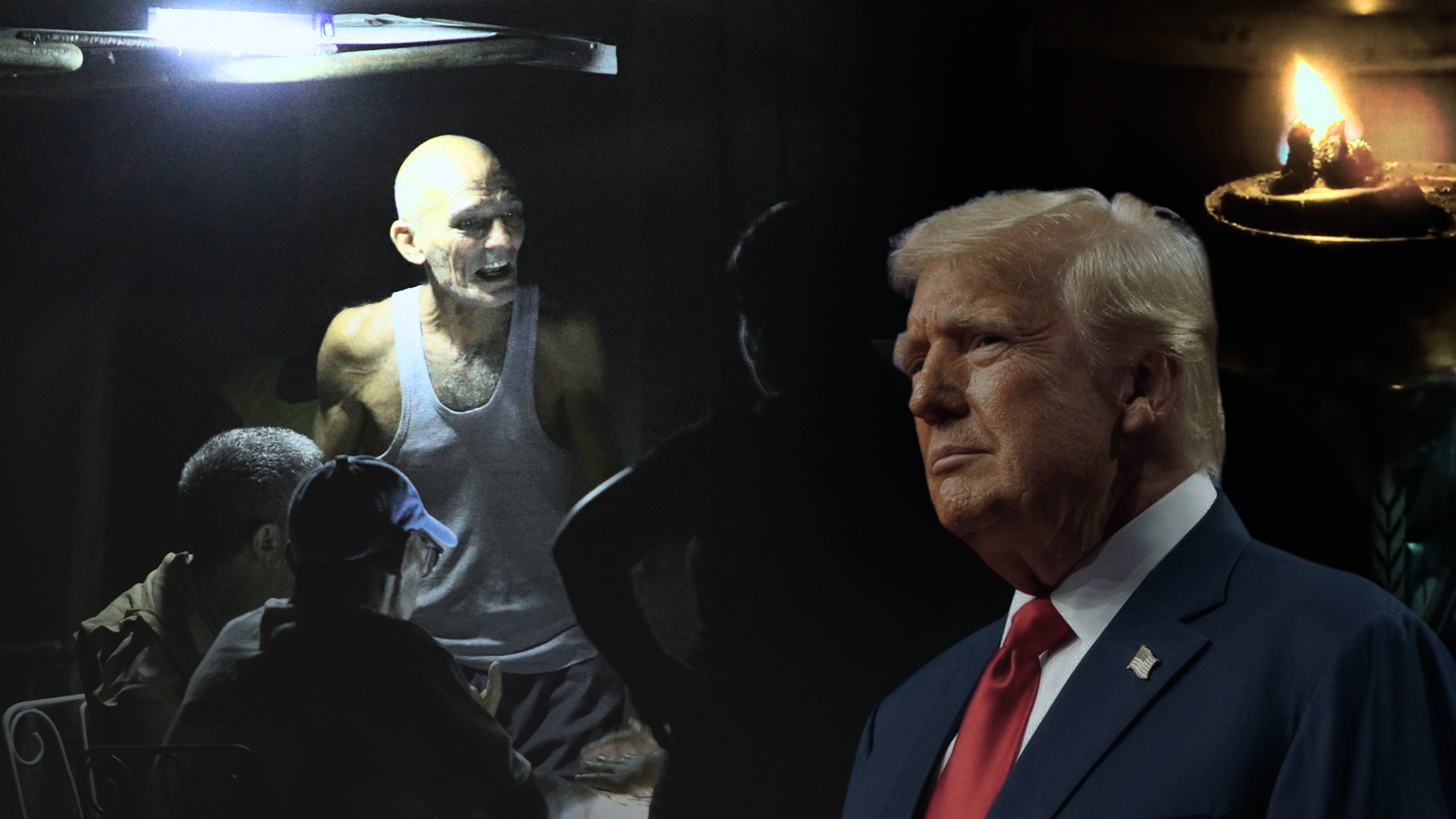
U.S. sanctions and an oil blockade have battered the Cuban economy and depleted the state of resources, leaving the country without the fuel and foreign currency needed to produce and import food and other basic goods.
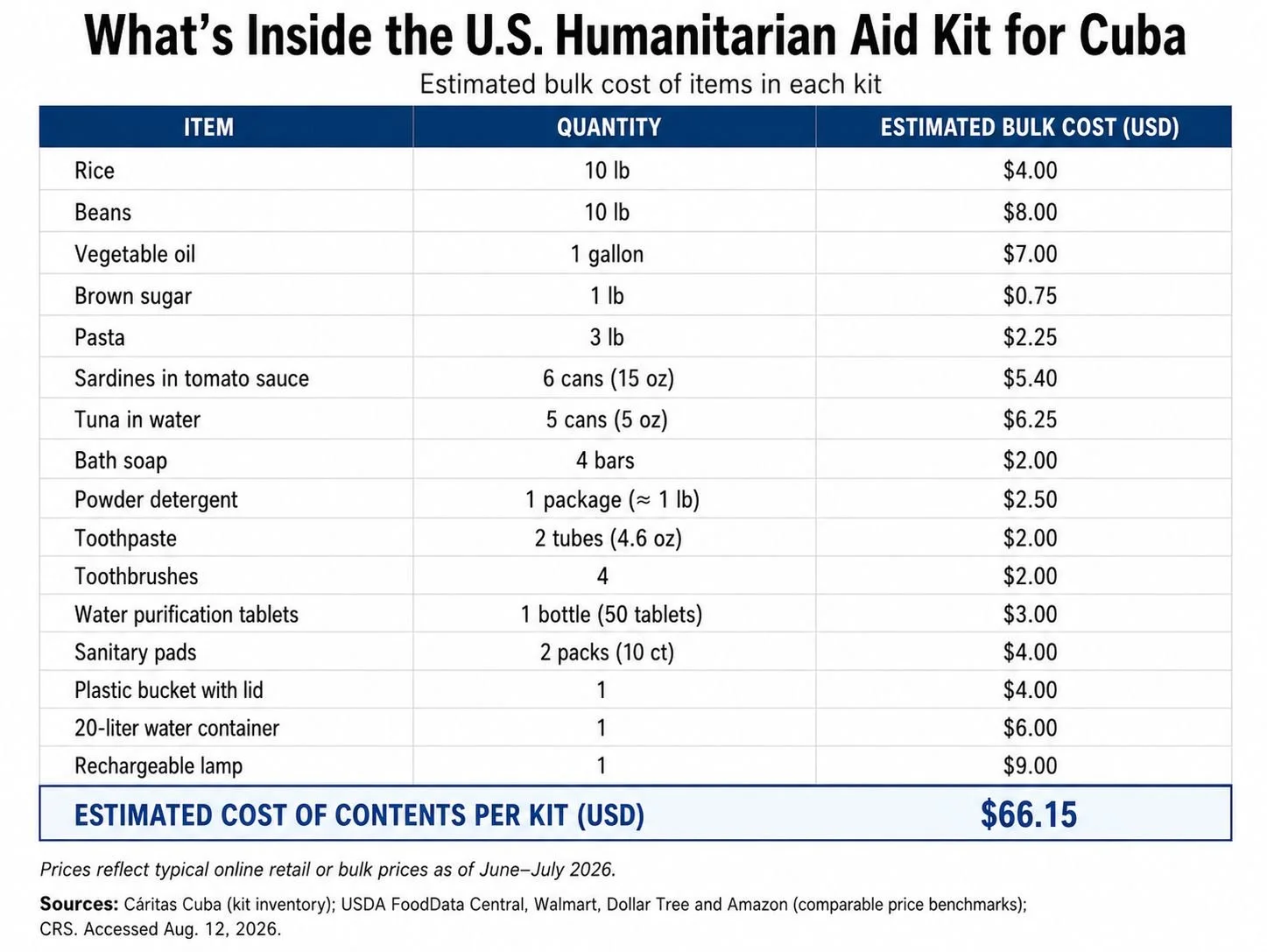
Most of the items inside the U.S. aid kits — which include rice, beans, sugar, cooking oil and soap — are the same staples the Cuban government used to provide its citizens through the libreta, or ration book.
But these days, the shelves of the country’s 12,000 state-run bodegas, where government subsidized food is distributed, are largely bare.
At a bodega in Bejucal, only powdered milk and beans were available.
“Almost the whole country is going through need now," said Danoy Díaz Pérez, who works behind the counter. "It's not just two or three vulnerable people anymore. It's nearly everyone."
Relief — For a Few Days
On May 13, the State Department announced a $100 million aid package for Cuba. Catholic Relief Services and Caritas Cuba were to receive $60 million of that amount to distribute "emergency food and hygiene supplies to nearly 200,000 households."
Each aid package is intended to meet the basic needs of a family of four for roughly 10 days. Cuban households often run larger — “up to 10 people in one house,” according to Father José Luis Sánchez Escalona, a priest in Bejucal who is coordinating the aid distribution there.
"It's not a solution to what people are going through,” said Sánchez Escalona. “But it is relief, at least for a few days."
That relief was available to only a fraction of those who needed it. Bejucal has a population of around 22,000 and Sánchez Escalona had just 380 kits to distribute. When word of the aid kits spread, some residents went to the church hoping to receive one, but left empty-handed.
A mother of three from Bejucal came to the church after missing the initial distribution. She was at the hospital with one of her children when volunteers went through her neighborhood identifying vulnerable residents.
"They told me they couldn't guarantee that more aid would come," she said. "But they put my name down."
For those who do receive a kit, the contents may end up stretching beyond a single household.
Nora Emilia Arias Llanes, 75, who lives alone in Bejucal, said she planned to divide her kit among herself and her four sisters. Beyond her family, she said she would give part of what she had to anyone else who needed it.
“All my life, I’ve tried to share not what I have left over, but what I actually have,” she said. “The little I’ve had, I’ve shared.”
A Drop in the Bucket
“We, in the U.S., are offering to help you not only alleviate the current crisis, but also to build a better future,” Secretary of State Marco Rubio said on May 20 in a pre-recorded message
directed at the Cuban people.
"That's strange," said Mercedes Gutiérrez, a 62 year-old retired teacher in Bejucal. "They want to blockade and attack Cuba, and then they are going to help?”
The $100 million in aid is a fraction of the $8 billion in losses the Cuban government estimates that U.S. sanctions have cost the country between March 2025 and February 2026. Since then, a January 29 executive order threatening tariffs on any country that ships oil to Cuba has plunged the island into an even deeper crisis.
Compared to the destructive impact of the U.S. oil blockade, the aid delivery is “a joke,” according to Emily Morris, a British economist who has studied Cuba since the early 1990s.
“Depriving the country of oil, the Trump administration is afflicting the food supply all over the country,” she said.
The United Nations’ human rights office reported in June that fuel shortages tied to the U.S. oil blockade have driven a 60% decrease in Cuba's domestic food production since January.
By cutting Cuba off from foreign revenue, sanctions have also impacted the government’s ability to import food, which is especially consequential for an island that depends heavily on imports. In 2025, Cuba spent roughly $2.8 billion on food imports, which account for an estimated 70 to 80 percent of what Cubans consume.
The $60 million provided to Caritas Cuba and Catholic Relief Services would amount to approximately 2% of Cuba’s total annual food imports. But even that figure may be generous given the potentially significant costs of aid delivery and distribution.
Assuming the official numbers — around $60 million for 200,000 kits (some of the money will also be spent on “essential household items” like mattresses and blankets for 7,000 Cuban homes) — each kit would cost close to $300. At online retail and bulk prices, the kit’s contents have a value of about $66, suggesting that much of the U.S. government grant money may be going toward distribution and overhead.
Neither Caritas Cuba nor Catholic Relief Services responded to questions about how the $60 million award would be spent.
The remaining $40 million is earmarked for other "highly trusted" NGOs. The State Department has not named which organizations are receiving that money nor explained what it’s meant to fund.
Creating the Crisis, Conditioning the Aid
The Trump administration refuses to work with the Cuban government in distributing the aid, claiming that Cuban officials would steal it. The administration has not presented any evidence to back up this claim.
Coordination with national governments is standard practice in responding to humanitarian crises, according to Francisco Pichón, the UN's resident coordinator in Cuba.
Working alongside the Cuban government is “essential for identifying the people who are most vulnerable” on the island, he told Belly of the Beast in June. “That cooperation is what allows aid to be distributed in the most direct and appropriate way possible.”
Other foreign governments typically work with Cuban state institutions to distribute aid. For example, food donations from Mexico and Korea have both been distributed through Cuba’s state-run bodegas.
Between Promise and Delivery
Getting U.S. aid to beneficiaries on the ground in Cuba has already proven to be a slow and complicated process.
After Hurricane Melissa battered the eastern part of the island last October, the U.S. government pledged disaster relief to Cuba as well as Jamaica, Haiti and the Bahamas.
Within two weeks, the Trump administration delivered 12,000 tarps and shelter kits to Jamaica from a Miami warehouse, while shelter kits and food assistance reached thousands of displaced people in Haiti, according to the State Department.
By mid-November, the U.S. had committed nearly $37 million to the region — over $22 million to Jamaica, $11 million to Haiti, $3 million to Cuba and $500,000 to the Bahamas.
The $3 million in aid for Cuba did not begin to ship until January 14, more than two and a half months after it was pledged.
Jeremy Lewin, the State Department official then overseeing the response, told reporters that providing disaster aid to Cuba is “complicated politically” — a reference to the administration’s insistence that the aid bypass the Cuban government and be routed instead through the Catholic Church.
Just like the hurricane aid, the $100 million aid package took months before it began to arrive. Bejucal and the nearby town of Alquízar received the first 700 kits on July 22, more than two months after the State Department’s announcement in May.
Once the aid arrives, getting it to the people who need it presents its own challenge. Fuel shortages caused by the U.S. oil blockade make aid delivery more difficult and expensive.
“The most urgent challenge is obviously the fuel [shortages],” said Pichon. “The UN system itself is being directly impacted by scarcities and the lack of fuel.”
In Bejucal, volunteers pushed boxes through the streets on dollies and loaded others onto a motorized tricycle. One resident donated five liters of fuel to help get the kits to recipients’ doors.
The aid delivery has been touted by the State Department and the U.S. Embassy in Havana, which posted social media videos of Chargé d'Affaires Mike Hammer, the top U.S. diplomat in Cuba, visiting the priest, church volunteers and aid recipients in Bejucal.
Belly of the Beast journalists were in Bejucal during one of Hammer’s visits, but he declined to answer any questions.
“A Publicity Stunt”
Reynaldo Acosta Martínez, 78, found out about the aid the same way many in Bejucal did — through word-of-mouth, after the recipients had already been selected. He wasn't on Caritas' list.
Acosta lives alone, relying on a retirement pension equivalent to less than $5 per month. Every few months, his great-grandson in the United States sends him $20 or $30.
“I’m barely surviving,” he said, pointing to an empty freezer.
Asked about the aid distribution, Acosta called the U.S. effort “a publicity stunt.”
"How can you impose a blockade and at the same time give us humanitarian aid?”
Share this Report
Related Stories