This Russian Base In Cuba Is Spying On You
July 22, 2026
Is Russia operating a spy base in Cuba again?
Donald Trump, Marco Rubio and major U.S. media outlets like The New York Times and The Wall Street Journal all say so.
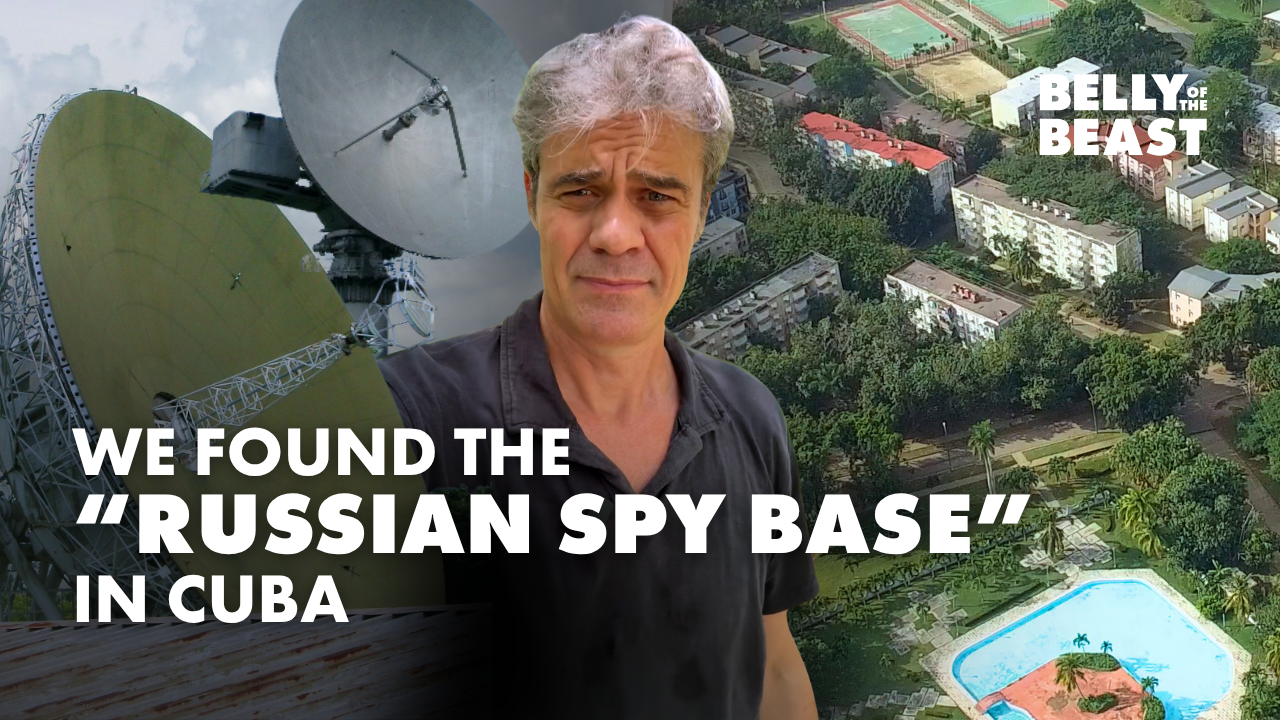
But none of them bothered to go to the alleged site of this spy base. We did — and here’s what we found.
Read our full investigation for additional reporting, historical context, photographs and sources HERE.
Related Stories
Share this Report
-
Liz Oliva Fernández, Belly of the Beast journalist, asks herself in front of a board: “Did you know the Russians are using my country, Cuba, to spy on the United States?”
News broadcasts had raised the alarm in stark terms: “Russia may be reopening a Soviet-era base in Cuba… Rebuilding Soviet military bases on the island… 150 miles from the coast of Florida… Evokes memories of the 1962 Cuban Missile Crisis.”
“I've never heard of any of this before. It sounds kind of made up. But it must be serious because Donald Trump has declared it a national emergency," Oliva Fernández said. Secretary of State Marco Rubio had made the same claim: "Cuba continues to host a pretty substantial collection of intelligence sites on behalf of the Chinese and the Russians.”
On the street, Cubans reacted with disbelief. "Then we would be the Russian spies," one person joked. Asked by Oliva Fernández, "Have you seen any Russian spies?" a driver replied simply, "Russian spies? No." An art professor laughed off the suggestion: "Do I look like a Russian spy?"
"Russia did have a spy base in Cuba during the Cold War. It was called Lourdes. The base closed in 2002. But according to The New York Times, the Russians reopened Lourdes 12 years later," the reporter explained. "One thing The New York Times didn't bother to do is actually go to where this spy base supposedly is," she added. "So, we're on our way."
At the site, Oliva Fernández described what she found: "So this is the Lourdes spy base. There're lots of buildings, but so far I'm not seeing any antennas, or any Russians, or many people at all for that matter. Finally, I found some!" She approached workers there: "Excuse me, would you mind if I asked you a few questions? Have you ever seen any Russians around here? Anything that might be a listening station? Any antennas that could be used for spying?"
The answers were consistent. A cook said, "No." A motorcycle driver said, "Russian spies, no." An employee named Lester said, "No Russians, no spies, no Russian relatives, nothing like that." Pressed on how he could be so sure, he said, "I've been here since 2002." Another worker suggested, "Go ahead and ask everyone who works here."
Art professors on campus offered a wry take. "Then we would be the Russian spies who have been here for 20 years," one said, adding, "That would push the limits of Russian creativity. A kind of tropical James Bond." Told that The New York Times said the base reopened in 2014, Lester was unequivocal: "No, there's no evidence whatsoever that this is true." A professor added, "I've spent my life here, and based on my experience, I can say categorically that the answer is no," and went further: "It's truly absurd that these kinds of claims are being made, and that major outlets like The New York Times give them a platform and allow them to be used to justify policies against Cuba."
The reporter then traced the base's history. "To understand Lourdes, we have to go back to October 1962. The Soviet Union deployed nuclear missiles in Cuba, just 90 miles from Florida. The Cuban missile crisis finally ended when Moscow withdrew its missiles from Cuba. But the Russians didn't leave Cuba. By 1964, Russia had built a fully operational espionage base," she said, noting that "Lourdes covered 28 square miles; the facility was home to up to 1,500 Soviet engineers, analysts, and intelligence officers," and that "if it moved through the airwaves over the southeastern U.S., Lourdes was trying to catch it. Phone calls, faxes, satellite communications, military transmissions."
"Former President Ronald Reagan warned the country about the base," Oliva Fernández noted. In a 1983 address, Reagan said: "My fellow Americans, thank you for sharing your time with me tonight… This 28 square mile facility has grown by more than 60 percent in size and capability during the past decade."
"But when the Cold War ended, the base was no longer needed. In 2001, Vladimir Putin announced that Russia would close Lourdes," the reporter said. "George W. Bush said the decision was a sign that the Cold War was over. But some people just can't let go of the Cold War." Among them, she said, was Rubio, who in a 2016 primary debate said: "Here's a good deal. Cuba kicks out the Russians from Lourdes and kicks out the Chinese listening station in Bejucal."
"That was in 2016. Marco Rubio was debating Donald Trump in the Republican Primary. Ten years later, Rubio finally got his chance to do something about the Russians at Lourdes," Oliva Fernández continued. "When Trump signed the executive order in January imposing an oil blockade on Cuba, Rubio's Russian spy-base narrative became White House policy. Corporate media outlets have jumped on board. The Wall Street Journal warned of Russian and Chinese spying from Cuba. And The New York Times pinpointed the location of the Russia spy base. Lourdes, said The Times, had re-opened and was now bristling with antennas."
She added dryly: "I'm going to be honest, I didn't know what 'bristles' means. I looked it up, the dictionary says: bristles means covered with or abundant in. Here's the thing, I haven't seen a single antenna yet." She went on to describe conditions on the island: "In the last six months, the U.S. oil blockade has made life in Cuba harder and harder. Blackouts are the norm. We're lucky to get three hours of electricity a day. There's barely any gasoline. Many people don't have water, or medicine, or food. There's no public transportation. The trash is piling up. The schools are shut down. The U.S. is imposing collective punishment on the Cuban people because according to Trump and Rubio, the island represents a national security threat to the United States because there is a Russian spy base at Lourdes."
Standing at the entrance of the site, the journalist said: "Welcome to the Russian spy base in Cuba, otherwise known as the University of Computer Sciences (UCI). As you can see behind me, there is a picture of Fidel Castro sitting next to a girl in front of a computer. She must be Russian, right?"
Yanio Hernández Heredia, president of Kainos S.A. at UCI, explained the layout: "UCI is located on the western outskirts of Havana," adding that "it's not really considered just a university. It's more like a campus or even a university town." Asked where Lourdes had stood, Hernández Heredia said, "Lourdes was located right here, on this site. But it ceased operations in 2001." He was one of UCI's first students when it opened its doors in 2002. Asked what those early days were like, he recalled: "It was quite unique because the university was built while it was already functioning. In fact, during the first years, we kept changing classrooms. So you started studying here, and then moved to another building as these larger buildings around us were being constructed." Asked whether the surrounding buildings dated to the Lourdes era, he said, "No. They weren't here during the Lourdes years nor when the university first opened."
"Pretty much all of these buildings, like the one behind me and this one over here, have been built in the last 20 years. They weren't here when this was the Russian spy base. Except this one. People here tell me it used to be a daycare center for the Russians," Oliva Fernández said.
Leodan Vega Izaguirre, director of the Center for Medical Informatics, where students develop medical software, told her: "I'll show you some of these places so you can see for yourself that we have nothing to hide." Asked, "No Russians hiding here?" he repeated, "No Russians hiding here. They're simply the workspaces used by our students." Noting how empty the space was, Vega Izaguirre said, "Sadly… because of the energy situation, all the students involved in this project are working remotely." Discussing the Cuban names of students who work there, he told her, "Here you'll find much more unusual names," citing "Nadieska over there, and Josué." When Oliva Fernández remarked that Nadieska "sounds like a Russian name," he said, "Well, it couldn't be more Cuban," adding that she is from "Guantánamo." Pressed on the U.S. State Department's spying claim, Vega Izaguirre said: "Not unless we can extract secret information from the U.S. through a medical image. Our work is entirely focused on software development, training students and contributing to the country's digital transformation." Asked if any Russian or Chinese personnel worked there, he said: "None. Everyone here is Cuban, mostly from the eastern part of the country."
"I'm on my way to talk to the rector of the University of Computer Sciences. He is the person who runs this place," Oliva Fernández said, noting that "UCI currently trains more than 2,500 undergraduate students. The Cuban government provides not only education in computer science, but also meals and housing for every student, professor and staff member at the university, all for free."
Raydel Montesino Perurena, rector of the University of Computer Sciences, welcomed her: "So, we're here at the UCI, a modern university that lives up to its name with a strong focus on computer science." He said the school had "deployed software solutions in most government entities" and "also developed solutions for citizens and the general public," adding, "That gives us technological sovereignty and contributes to the country's development." Asked whether he had heard of Russian intelligence bases, Montesino Perurena said, "Not at all. By 2014, this was already a major university." He acknowledged some contact with Russians: "Have I seen Russians? Yes, of course. I've seen Russians who have come here from academic institutions. Today, we have partnerships with 120 institutions from more than 20 countries." Asked whether the university could serve as cover for an intelligence facility, the rector said: "You can see it for yourself. There's nothing hidden. Nothing being concealed. These are educational facilities, classrooms, computer labs." He explained the campus's emptiness: "Right now, you won't see many students here because of the energy blockade. Higher education has been unable to keep students on campus. Universities have had to shift to remote and hybrid learning."
"There aren't any students here because there's no fuel. There's no fuel because there's an oil blockade. There's an oil blockade because according to Trump, there weren't any students here to begin with. Just Russian spies. They should be around here somewhere, right?" Oliva Fernández said.
Aylin Estrada Velazco, dean of the Open Technologies School at UCI, identified one building: "This is the José Martí building," which houses "20 classrooms, five lecture halls, and 12 teaching laboratories, all used for instruction. The administrative offices are also located here," as well as "the National Center for Distance Education and the Teacher Training Center." Asked if there were Russians in the building, Estrada Velazco said, "No. This is an academic building. We teach computer science here." Asked if anyone there was developing spyware, she said, "No. Not at all," and lamented the empty halls: "It's a shame our students aren't here today because this place is usually full of them, walking through the halls, smiling, learning." She agreed to give a tour: "Right now, the campus feels quiet and empty. That's not how we like to see it. We're used to seeing it full of young people." Walking the halls, she said, "Look, throughout this entire wing, on the second floor, all of these rooms are classrooms," adding of the empty classrooms, "These classrooms aren't just for teaching. They're also for sharing knowledge, science. It's a shame they're empty. We can't wait for our students to come back."
Oliva Fernández next got a ride with Rafael Torralbas Ezpeleta, president of the Havana Science and Technology Park. "Rafael, tell me a little about what you do. What's your role here?" she asked. Torralbas Ezpeleta said, "My role here is to lead the Havana Scientific and Technological Park, which is a new type of institution. It was created in 2020 as part of the ongoing development of the UCI." The reporter noted, "The Technological Park of Havana was inspired by Silicon Valley. It is an incubator for Cuban tech startups, most of them private companies. The park also provides technological support to foreign and state-run companies," and that "it stands where Soviet antennas once intercepted U.S. government communications."
She asked him about his role in the site's transformation: "I understand that you were one of the first Cubans to set foot on this site during the transition process, after the Lourdes base was closed in 2001 and before this new project was created, the University of Computer Sciences. Can you tell me what that process was like?" Torralbas Ezpeleta recalled, "I didn't know this place. I had heard about it in the news," and that "on April 20, 2002, I arrived at this site with two other colleagues. I was mainly responsible for overseeing the investment, while the other two were in charge of the initial planning and concept of what the university would become." Asked what he saw on his first visit, he said: "What stood out the most was that this place had different sites with very large antennas. I witnessed the entire process of dismantling those antennas. Of course, all of those antennas had associated technological equipment that we never saw. We knew the equipment was there, but the Russian officials removed everything and handed the facilities over to us completely cleared out." He added, "If you look at 100% of the facilities that make up the UCI, only about 15 to 20 percent had been built at that time. Everything else was built from scratch."
Told that reports pointed to a 2014 reopening through a Cuba-Russia cooperation agreement, Torralbas Ezpeleta said, "If that reopening existed, I think it could only exist in the mind of whoever created that story," explaining that "in 2014, the park had not been created yet, but the university, more or less as you see it today, was already fully established." Walking the grounds, he pointed out where the antennas once stood: "Where we're walking now, there used to be a group of antennas that captured the signals processed inside those buildings," which "were located in those areas. For example, the place where you were at, the rector's office, served as a kind of command center for this entire site… That was where all the information collected here was processed." He concluded, "But as you can see, none of the facilities that existed back then remain. That's why I say a facility like that would be extremely difficult to conceal."
"Everyone I spoke to insisted there was no spy base here. But I wanted to see for myself. So I walked all over the campus, went into buildings, and drove around the perimeter. Then, finally, I found an antenna," Oliva Fernández said. She asked a passerby, "Excuse me. Do you know what that antenna's for?" Héctor Elider González Rodríguez, deputy director of the Communications Department at UCI, explained: "That's ETECSA's antenna. It provides cell phone coverage for the entire university campus." Asked, "A cell tower?" he confirmed, "Yes, it's a mobile phone tower. That's what gives our cell phones signal." Pressed on how he could tell it wasn't a surveillance antenna, González Rodríguez said, "I don't know much about telecommunications, but all mobile phone towers look pretty much like this." Asked how many such antennas existed on campus, he said, "We have two. This one is located here on this side of the campus, and there's another one near the far end. It basically extends the coverage from this one," confirming, "Just two, yes… We depend on these two because we're so far from the city." Asked about nearby buildings, he identified them as "student dormitories," adding, "Yes, students live here… They're empty right now." Asked whether Russian students lived there, he said, "No, Cuban students. They're all Cuban nationals," and that he had never seen Russian students, spies, or soldiers there: "No. No Russians at all." Asked why he laughed at the questions, González Rodríguez said, "No. It's interesting that, after all this time since the Russians left, people are still asking as if there were still Russians here."
"Not everyone living on campus is a student," the reporter noted. "Yarina works at the university. She is the director of Extracurricular Activities. She has lived inside the campus since 2016 with her husband and their nine-year-old daughter Paola." Yerania Sardá, director of Extracurricular Activities at UCI, said, "My husband and I met in 2016. We got married, he'd been working here since 2008." Asked if he had graduated from UCI, her husband said, "No. I graduated from the Central University of Las Villas, in Computer Science in 2008," and explained what brought him there: "I came here to work, and I stayed. As you can see, I've built my family here."
Asked what life was like on campus, Sardá said, "Right now, the university offers all kinds of services. We have a medical clinic. There's a hospital here. We also have a bakery," and that "we have dining halls, where all the families living here get breakfast, lunch and dinner." She described the hardships of the blockade: "The hardest part for us is the distance. We had a transportation system that was running until February. It probably used the country's last drop of oil. They kept it going because our kids don't go to school here. They attend schools in La Lisa, which is the closest place to us." Asked whether Russian families once lived in her building, Sardá said, "Well, based on the construction, we assume so. We never saw any [Russian] residents or had any contact with them, but the construction suggests it."
Invited inside, Sardá showed the reporter around: "Come on in." Touring the kitchen, freezer, and patio, Oliva Fernández asked young Paola, "You don't happen to have anyone hiding inside the freezer, do you?" Paola answered, "No." Sardá pointed out "the little patio where we hang the laundry" and "a water tank because water is scarce," as well as "the baby's room" and "the biggest bedroom," noting of an unused room, "This room isn't used much, since she shares a room with us." Wrapping up the visit, Oliva Fernández said, "Thanks so much for showing me your house. I really liked it."
Closing the piece, Oliva Fernández said: "We looked everywhere. No Russian spies. No evidence that there is a spy base. So if Donald Trump, Marco Rubio and The New York Times are telling the truth, that would leave only one explanation. The Russians are really good at hiding."
Support Independent Journalism from Cuba