Paul Farmer’s Nobel Peace Prize Nomination Letter for the Cuban International Medical Brigade
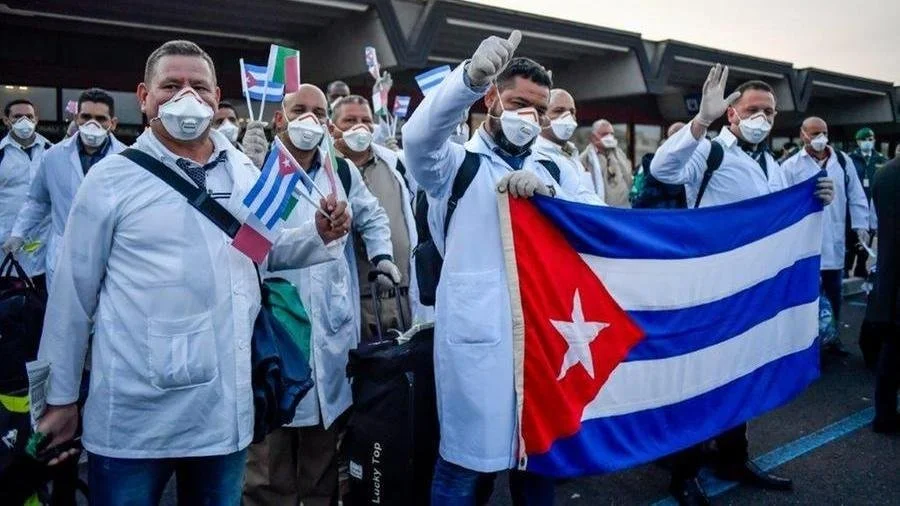
As the Trump administration continues its assault against Cuba’s medical missions — portraying them as “forced labor” and pressuring countries to reject Cuban doctors — it is worth revisiting the words of those who have worked alongside them.
For years, the story of Cuba’s health internationalism has been told by U.S. politicians and major media outlets that depict the missions as exploitative. Missing from that conversation are the voices of many of the patients, health professionals and public health experts who have worked with Cuban doctors around the world.
In 2007, the late Dr. Paul Farmer, founder of Partners in Health and one of the leading voices in global public health, nominated Cuba’s International Medical Brigade for the Nobel Peace Prize. Drawing on years of experience working alongside Cuban doctors in Haiti, Farmer described their commitment to serving poor and disaster-stricken communities as “astonishing” and argued that their work was “eminently deserving of the Nobel Peace Prize.”
Farmer’s assessment stands in stark contrast to the narrative promoted by Washington today. Rather than a system of coercion, he saw a medical corps delivering lifesaving care in places where few others were willing to go. His perspective is shared by countless patients, healthcare workers and health officials who have witnessed Cuba’s medical cooperation programs firsthand.
Harvard Medical School
Department of Social Medicine
May 5, 2007
The Norwegian Nobel Institute
Henrik Ibsens gt. 51
NO-0255 Oslo
Honorable Sirs:
In honor of more than four decades of generous spirit, humanitarian vision, and dedication through service to the basic rights of humankind, I am pleased to nominate the International Cuban Medical Brigade for the 2008 Nobel Peace Prize.
For more than 40 years, Cuba has dispatched doctors, nurses and other medical personnel to impoverished third world countries. More than 42,000 Cuban health professionals have worked in 93 countries as part of an international medical brigade since the 1959 revolution, responding both to earthquakes and other natural disasters and to the chronic disaster of disease, poverty and lack of medical resources.
Barely a year after the revolution, Cuba sent its first emergency medical team to Chile after the most intense earthquake ever recorded. A few years later, the first Cuban medical team touched down on the African continent, in Algeria. Almost without interruption, Cuban doctors and nurses have been working in numerous African countries ever since.
One of my colleagues at Partners In Health traveled in Africa as a journalist in 1970. He recalls a group of schoolchildren in rebel-controlled territory of what is now Guinea-Bissau serenading him with a song whose lyrics proudly proclaimed:
“When I grow up I will be a good nurse, like Amelia, like a Cuban.”
At the forefront of every major international relief effort—from Chile in 1960 to Pakistan in 2005—you will find Cuban medical professionals at work, regardless of the ideological orientation of the afflicted countries.
This includes Cuba’s offer to send 1,600 doctors trained in disaster relief and 36 tons of medical supplies to flood-ravaged Louisiana and neighboring states following Hurricane Katrina. Rebuffed by the Bush administration, the offer by a small, developing country that has suffered forty-five years of U.S. hostilities, including an economic embargo, represented a powerful testimonial to humanitarian principles.
Responding to the earthquake in Pakistan in 2005, the Cuban medical brigade made it possible for 73 percent of the patients of this disaster to be attended by Cuban doctors and paramedics.
Cuba’s medical system is widely recognized as one of the best in the world and offers much to admire, but nothing so much as the international medical brigade. Hundreds—even thousands—of lives have been saved through the efforts over several decades of its volunteer doctors, who are committed to expanding the frontiers of medicine and science and to providing health care to the poor of the world.
They do this despite personal risk of malaria and dengue, despite the hardship that comes from being away from home for two years, without any expectation of personal gain. Both their personal lives and their medical practice embody a commitment to community-based public health.
They live in the barrios and villages of the poor, not in gated enclaves of professionals. And they work with their neighbors to identify and confront these communities’ most pressing health problems.
Among people concerned about the global crisis in access to health care, the worldwide reach and village-level impact of Cuba’s medical brigades is widely recognized and much admired.
Their work has been depicted in film (¡Salud!, released in 2006) and has been described and analyzed in both the commercial and medical press.
I will quote just one recent example:
“Over the past forty-five years, Cuba’s conduct of medical diplomacy has improved the health of the less privileged in developing countries while improving relations with their governments. By the close of 2005, Cuban medical personnel were collaborating in 68 countries across the globe. Consequently, Cuban medical aid has affected the lives of millions of people in developing countries each year. And to make this effort more sustainable, over the years thousands of developing country medical personnel have received free education and training either in Cuba or by Cubans in on-the-job training courses or medical schools in their own countries. Today, over 10,000 developing country scholarship students are studying in Cuban medical schools. Furthermore, Cuba has not missed a single opportunity to offer and supply disaster relief assistance irrespective of whether or not Cuba had good relations with that government.”
— Julie Feinsilver, Cuban Medical Diplomacy: When the Left Has Got It Right
I could cite numerous other articles. I could name dozens of fellow doctors and global health advocates who would be glad to testify in support of this nomination.
What I can speak about with first-hand knowledge, heartfelt gratitude and profound respect are the individual Cuban doctors and nurses with whom I have had the privilege to work and the invaluable contributions they have made to saving and improving lives in destitute communities that I know intimately and care about deeply.
For the past 20 years, I have lived and practiced medicine in the island nation of Haiti, by all measures the poorest and most disease-ravaged country in the Western Hemisphere.
The partner Haitian and U.S.-based organizations with which I have worked—Zanmi Lasante and Partners In Health—introduced the first-ever full-service clinic to a remote, mountainous area in the middle of the country.
Starting with a small staff and few resources, we have dedicated ourselves to treating the twin epidemics of HIV/AIDS and tuberculosis that have ravaged the population and given Haiti the highest burden of HIV/AIDS in the Americas.
Haiti has a lethally inadequate number of doctors and other healthcare personnel to fight both these headline-grabbing diseases and the more prosaic plagues of poverty that continue to kill Haitians by the thousands—diarrhea, pneumonia, complications in pregnancy and childbirth, hunger and malnutrition.
In rural parts of the country, the ratio is one doctor to every 20,000 patients.
In the face of this deplorable situation, it is not surprising that many of the residents of the Central Plateau had never had medical care until Zanmi Lasante brought in doctors, eliminated user fees, and started training and employing local people as community health workers.
Cuba has long recognized its close neighbor’s desperate need for help, particularly in the area of health.
In 1998, Cuba devised a comprehensive plan of humanitarian aid for the Haitian people, bringing in a 525-member medical brigade, including 332 doctors.
Composed mainly of young people, along with some very experienced professionals, the brigade spanned all specialties.
Scattered throughout the country, Cuba’s medical personnel provided health care for 75 percent of the country’s 8.3 million people.
In this five-year period, Cuban doctors treated nearly 5 million Haitians, and infant and maternal mortality rates declined dramatically.
In 2004, Cuba sent Haiti 12.2 tons of medicines so that its medical personnel could fulfill their tasks.
Some 600 Cuban doctors and nurses now work in some of Haiti’s most destitute areas.
That this has been accomplished without fanfare or recognition, and all the while abiding by the principle of neutrality and non-interference in Haiti’s internal affairs, makes it all the more astonishing.
As part of this outreach program, more than two dozen Cuban doctors and nurses have been assigned to our Central Plateau clinics and hospitals, including the Clinique Bon Sauveur, where we have received two senior surgeons and two senior pediatricians.
They bring with them not only impressive medical skills but an optimism of spirit and dedication to service that have long been in short supply in a country where medical professionals must cope with rampant disease, a crumbling health system, and a crippling lack of resources for the task at hand.
The Cuban doctors receive no salary for their work—only a small monthly stipend of $20.
The value of their work is incalculable.
I’ve worked very closely with four of these stellar volunteers, who rotated through for two years each, each of whom reported to me as medical director of the Clinique Bon Sauveur.
Each of these senior physicians was a paragon of clinical competence and professionalism.
After working with them closely for four years, and having seen dozens of other Cuban professionals in Haiti, I feel that the example set by these four specialists was typical of the brigades in general.
In addition to the wonderful example set for Haitian colleagues, it should be noted that Cuban professionals have also worked to alleviate Haiti’s healthcare crisis by training Haitian medical personnel.
Cuba donated extensive teaching materials and assumed responsibility for instruction at a new Haitian medical school launched in 2003.
The new graduates were asked to pledge to work in Haiti for at least ten years as an attempt to address the human resource scarcity there.
But in 2004, two years into operations, Haiti suffered a coup d’état and lost its elected government.
Public services in the country virtually shut down. The medical school closed, its Cuban faculty left, and U.S. soldiers moved onto the school grounds, which had been converted into military barracks for the UN peacekeeping forces.
But the Cuban doctors assigned to Clinique Bon Sauveur have remained at their posts, as did hundreds of others throughout Haiti.
Their steadfast dedication to providing quality health care in the face of crushing poverty and precarious security exemplifies the work of the Cuban International Medical Brigade—a work that is eminently deserving of the Nobel Peace Prize.
With my best wishes,
Yours sincerely,
Paul Farmer, M.D., Ph.D.
Professor of Medical Anthropology
Associate Chief, Division of Social Medicine and Health Inequalities
Brigham and Women’s Hospital
Vice Chair, Department of Social Medicine
Harvard Medical School
Founding Director, Partners In Health
Medical Director, Clinique Bon Sauveur
Cange, Haiti
Related Stories
Support Independent Journalism from Cuba

Share this Report