
Who’s Behind the Poll Claiming Cubans Would Support a U.S. Invasion?
September 17, 2026
By Blake Burdge
This story was published in collaboration with Drop Site News.
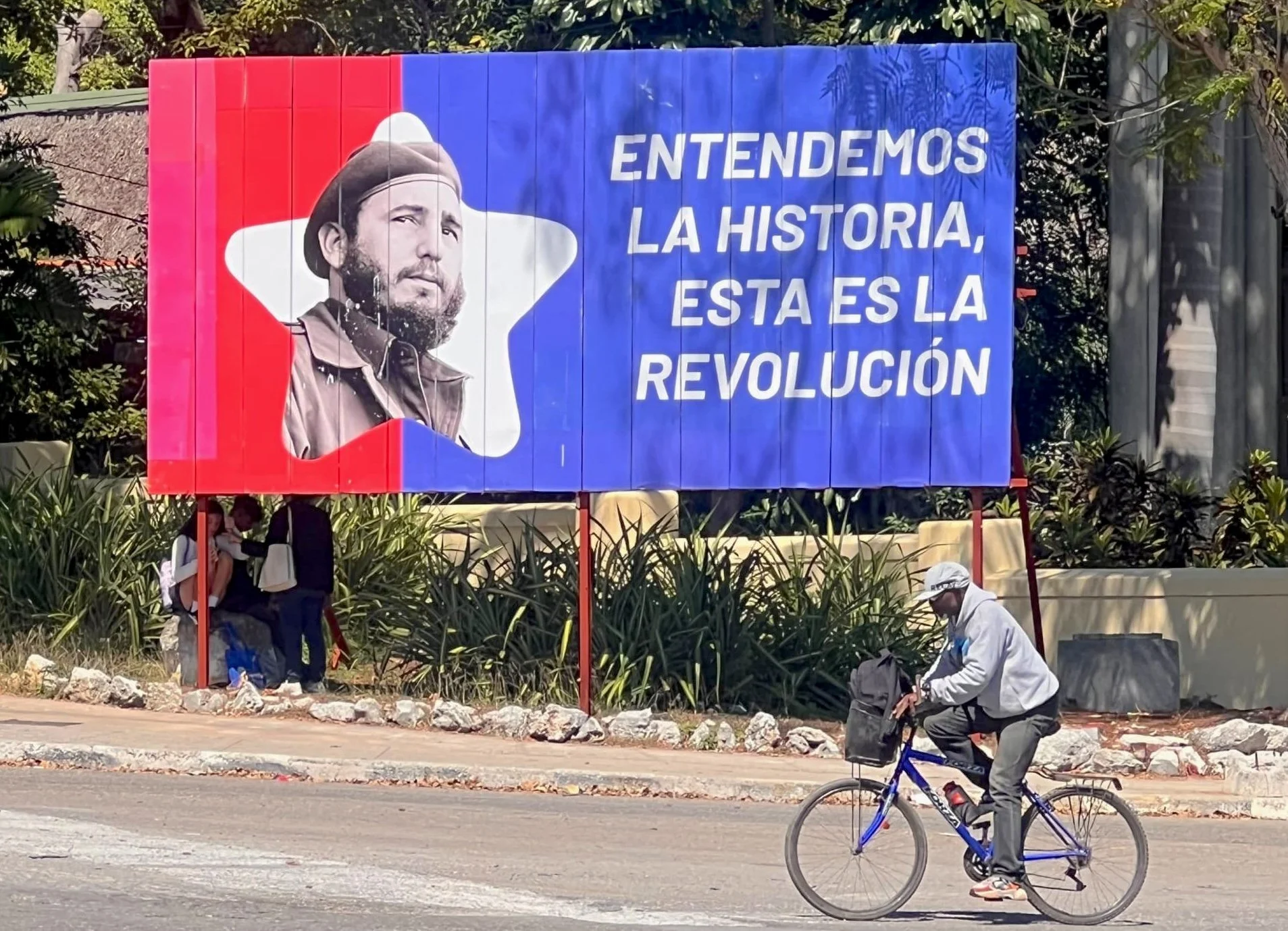
A cyclist in Havana passes a billboard featuring Fidel Castro and the slogan “We understand history. This is the revolution.” Photo: Belly of the Beast.
In September, a rare public opinion poll backed by two major U.S. universities suggested that Cubans overwhelmingly blame their own government for the country's economic crisis and do not oppose a U.S. military intervention.
The results appeared to vindicate the Trump administration's hard-line policies toward the island.
But a close look at the survey, which has been promoted as “the first-ever nationally representative study” of Cuba and has been cited by PBS NewsHour, Americas Quarterly and Foreign Affairs, reveals a stark disconnect between how the poll was presented and what its findings actually show.
Media coverage also failed to examine the millions of dollars in U.S. government funding received by the organizations connected to the poll—including for programs aimed at influencing the very public opinion the survey sought to measure.
The Money Behind the Poll
The poll was overseen by Vanderbilt University’s Latin American Public Opinion Project Lab (LAPOP), which describes its flagship survey, AmericasBarometer, as “the leading source of comparative public opinion data on democracy and governance across the Americas” since 2004.
Data from AmericasBarometer frequently appears in State Department reports, academic research and the World Bank’s “governance indicators.”
Every two or three years, AmericasBarometer publishes a region-wide report called Pulse of Democracy. This year’s report features polls from 21 countries, including, for the first time, Cuba.
For the Cuba poll, LAPOP contracted a company called CubaData (incorporated in Titusville, Florida, as Cuba Data LLC) that specializes in conducting digital surveys on the island via cell phone.
CubaData is co-owned by Pablo Díaz Espí, a Cuban exile who left the island for Germany shortly after the fall of the Berlin Wall. Díaz Espí has lived between Berlin and Spain where he is the founder of a Madrid-based news outlet called Diario de Cuba whose agenda is to “go for the jugular of Castroism.”
Both Diario de Cuba and CubaData have been the beneficiaries of U.S. government funding.
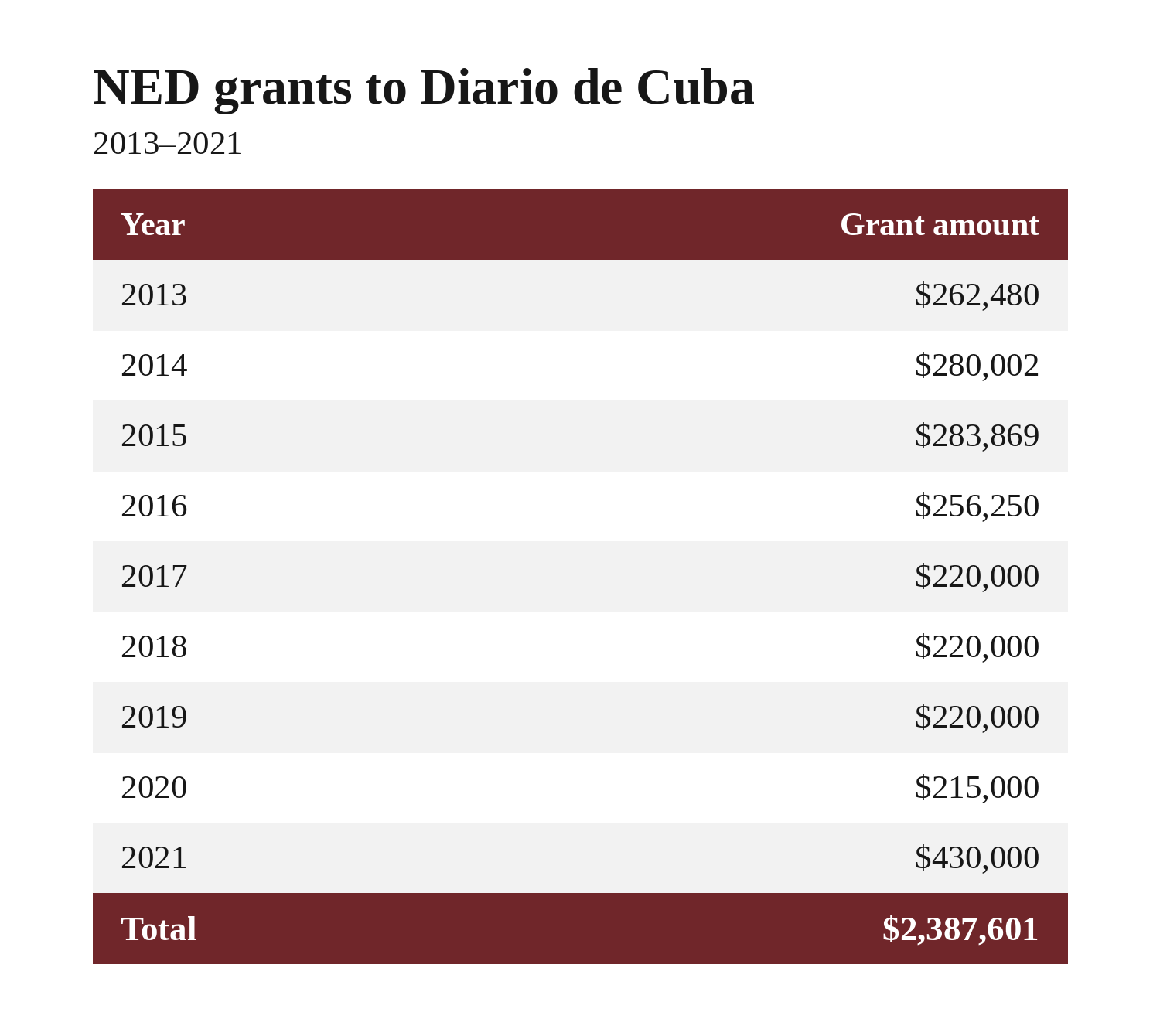
Between 2013 and 2021, Diario de Cuba received grants totaling at least $2.3 million from the National Endowment for Democracy (NED), according to figures published in annual reports, academic studies, and news articles. NED describes itself as a non-governmental organization that “promotes democracy” around the world, but it receives its entire budget from Congress and has assumed many of the CIA’s former activities, funding political parties, unions, media outlets, and other civil society organizations to advance U.S. foreign policy objectives.
“A lot of what we do today was done covertly 25 years ago by the CIA,” Allen Weinstein, a former NED president, told the Washington Post in 1991.
In 2026, NED is disbursing $8.5 million in Cuba grants, including programs to “challenge the state’s narrative by exposing regime failures,” expose the Cuban government’s “malign influence in Latin America,” and disseminate research on dismantling Cuba’s power structures in a “post-authoritarian context.”
Whether Diario de Cuba has continued to receive funding is difficult to determine because NED no longer publicly identifies many grant recipients, a policy it says is intended to protect them from government retaliation. However, last year, NED President Damon Wilson and board member Mel Martínez, a former Republican senator from Florida, praised reporting by NED partners, including Diario de Cuba, saying they “undermine the regime’s legitimacy.”
In addition to NED funding, Diario de Cuba has also received money from the State Department. In September 2020, the U.S. Embassy in Havana awarded the outlet a $12,960 contract for news-monitoring services, according to federal procurement records. In 2022, the outlet received a $530,000 State Department grant “to strengthen Cuban civil society and boost youth participation in advancing democratic demands,” according to the federal grant database HigherGov.
CubaData has also received funding from NED.
In 2021, the company was the beneficiary of a $500,000 grant awarded to the National Democratic Institute (NDI), an organization affiliated with the Democratic Party that was established to receive NED funding and carry out U.S.-funded democracy-promotion programs abroad. NDI contracted CubaData to use polling data “to analyze Cubans’ needs, perceptions and beliefs about topics of public interest.”
At the time, NDI’s Cuba program was headed by Karla Velásquez Figuera, a Venezuelan lawyer based in Mexico who served as an intermediary between Cuban dissidents and the State Department, according to The Washington Post. Cuban state television aired intercepted telephone and text exchanges between Velásquez and dissidents, portraying her as the “godmother” of the San Isidro Movement, a prominent anti-government organization.
Velásquez also carried out “training” activities at Diario de Cuba for Díaz Espí. The experience, she said in a recent interview, led to her later being hired as project director for CubaData.
In a 2025 CubaData report about “latent dissidence” in Cuba, Velásquez thanked NED and NDI for making it possible to implement the study's data-collection methodology.
Velásquez did not respond to a request for comment about her work with NDI, Diario de Cuba and CubaData.
CubaData runs its polls through a mobile phone app called Apretaste, which is owned by a software developer called Agora Cuba, a nonprofit organization incorporated at the same Titusville, Florida address as CubaData.
Agora Cuba’s executive director is Salvador “Salvi” Pascual, a Cuban-born technology entrepreneur based in Florida who co-founded CubaData with Díaz Espí in 2018. Agora Cuba, like Diario de Cuba and CubaData, has received U.S. government funding.
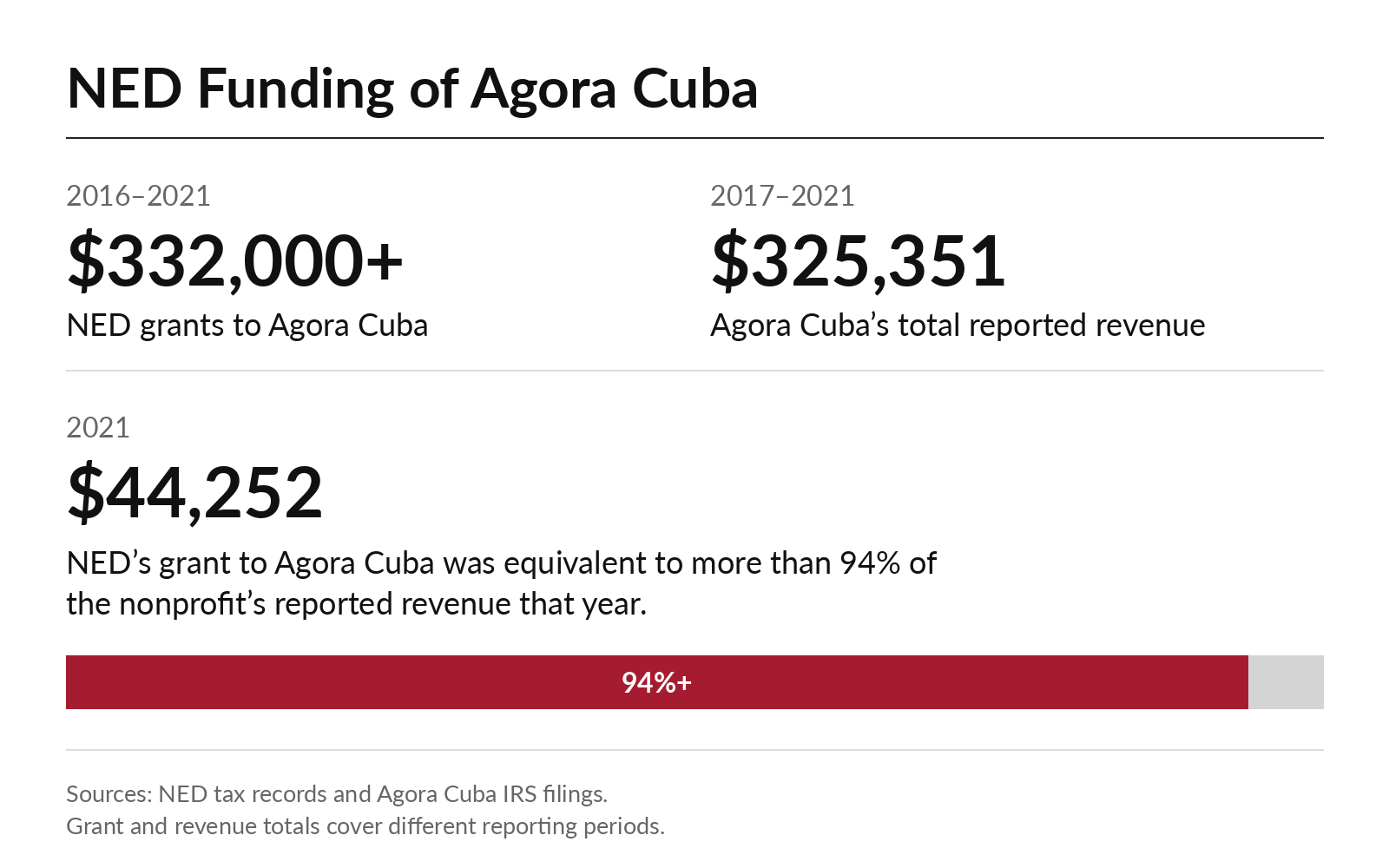
Between 2016 and 2021, NED’s tax records document more than $332,000 in grants to Agora Cuba, according to NED’s grant listings and tax filings. An NED grant of $44,252 listed for 2021 was equivalent to more than 94 percent of Agora Cuba’s reported revenue that year.
LAPOP itself has also long relied on U.S. government funding. In October 2024, Vanderbilt announced a five-year, $12.5 million USAID award to support the project and other surveys. USAID was reportedly supplying about 70 percent of LAPOP’s AmericasBarometer’s budget.
But that funding was cut off in 2025 when Elon Musk’s Department of Government Efficiency (DOGE) dismantled USAID.
Notre Dame’s Kellogg Institute for International Studies stepped in to help fund half of this year’s AmericasBarometer budget, according to the school’s campus newspaper The Observer. Vanderbilt University officials contacted by Belly of the Beast and Drop Site did not respond to questions about how they funded the other half.
U.S.-Funded Apps
The U.S. government has long funded media and communications projects aimed at bringing about regime change in Cuba.
Journalist Tracey Eaton documented more than $218 million in U.S. government disbursements for Cuba “democracy promotion” (also known as “regime change”) programs between 2001 and 2021. Roughly $25 million went to media and information projects, of which NED managed $15.6 million.
Some programs have clearly stated their intentions. For example, a 2019 USAID initiative offered up to $2 million for projects that would “dispel the myths about the successes of the Cuban Revolution,” including its education and healthcare systems.
Other programs were covert. One of the most notorious was ZunZuneo, a text-message network modeled on Twitter that launched in Cuba in 2010 thanks to $1.7 million in funding from USAID.
ZunZuneo’s plan was to attract subscribers with sports, music, and weather updates, and then introduce political content that could spark anti-government protests, according to documents obtained by the Associated Press in 2014.
More than 40,000 Cubans used the network without knowing the U.S. government was behind it.
The revelations embarrassed USAID and led to Congress grilling its administrator, Rajiv Shah. Sen. Patrick Leahy (D-Vt.), who chaired the subcommittee overseeing the agency’s funding, called the project “dumb, dumb, dumb.”
More than a decade later, the U.S. government is surreptitiously funding another social media app aimed at Cubans.
Apretaste, the app CubaData uses to recruit and register its survey respondents, bills itself as a free social network for Cubans, promising users the freedom to express themselves “without fear of censorship.” Its app-store listings name Agora Cuba as its developer but make no mention of its NED funding.
Salvador Pascual, Agora Cuba’s executive director, told EFE in a 2016 interview that the app would be used to conduct market research and polling for U.S. companies. “We are the only ones who have this information about Cuban people, who also want to socialize,” he said.
The app has been used repeatedly to recruit people to participate in polls conducted by CubaData, which is run by Díaz Espí. Those polls in turn are regularly publicized in Díaz Espí’s Diario de Cuba.
Asked about the potential for bias in hiring a polling organization that is both funded by the U.S. government and led by an outspoken exile known for his anti-government activism, Jordan responded that LAPOP “adheres to rigorous scientific standards to ensure that its research is non-partisan.”
In a written response via email, Díaz Espí told Belly of the Beast and Drop Site that Diario de Cuba did not participate in the LAPOP survey or share staff, resources or user databases with CubaData or Agora Cuba. He said he did not participate in the survey’s design, implementation or analysis, and that his own role was “exclusively institutional.” He did not specify what that meant.
He said NED and NDI supported separate, earlier research conducted by CubaData, but did not finance LAPOP’s Cuba poll.
Pascual did not respond to requests for comment.
How Blame Became the Headline
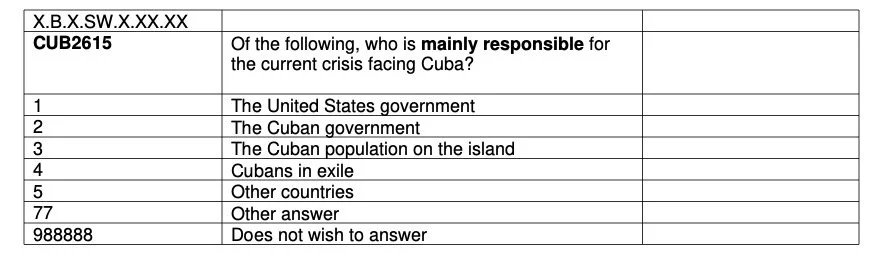
The Cuba poll asked 73 questions, but one of them has dominated media coverage of it: “Who is primarily responsible for the current crisis facing Cuba?”
Respondents could make only one choice.
Seventy-four percent chose the Cuban government. Sixteen percent chose the U.S. government.
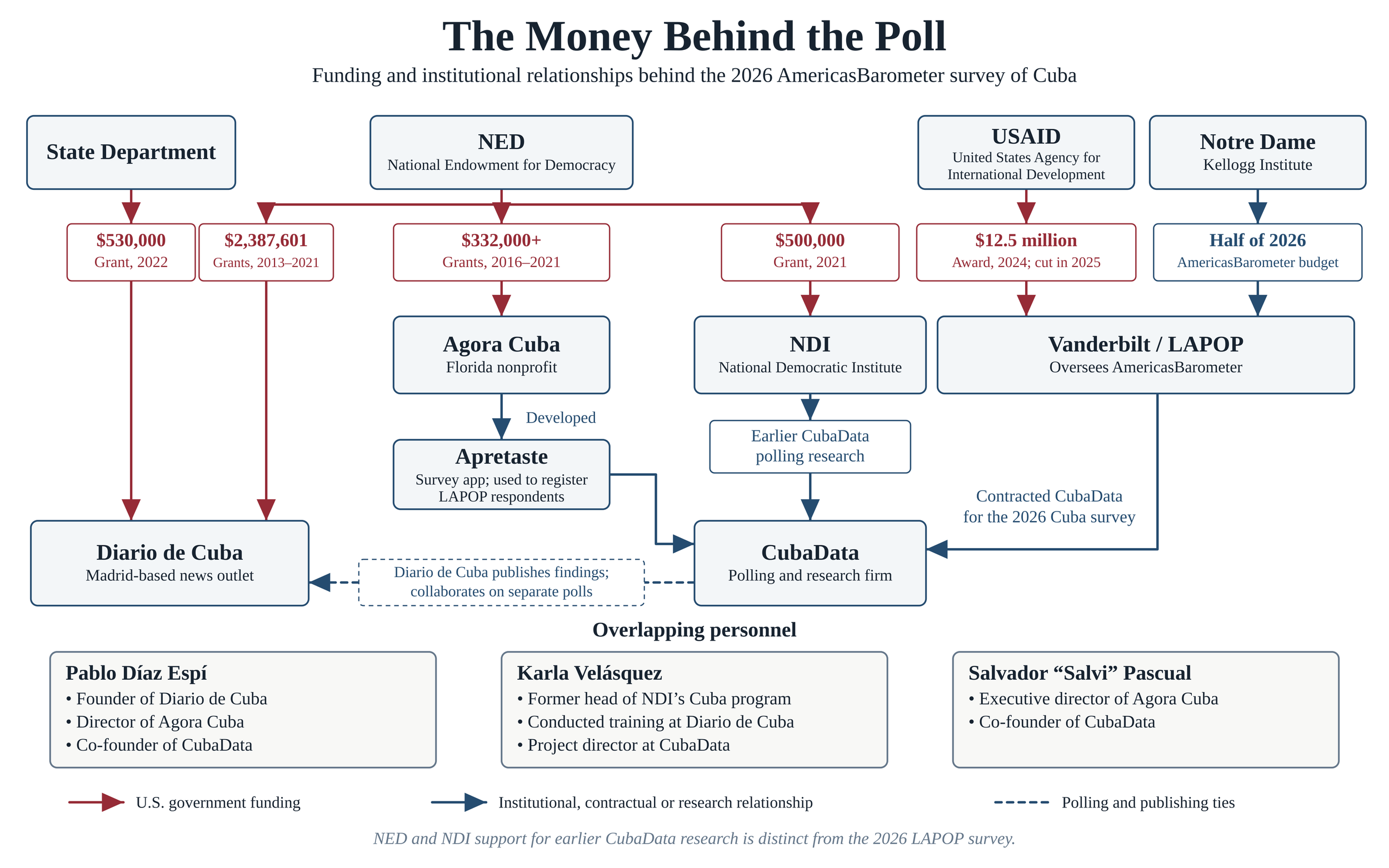
U.S. government funding and institutional ties among the organizations involved in the 2026 AmericasBarometer survey of Cuba. Sources: NED grant records and tax filings, federal spending records, Florida corporate records, LAPOP technical documentation, CubaData, Diario de Cuba and interviews conducted by Belly of the Beast.
Another question allowed respondents to assign blame to multiple actors. More than 45% attributed the crisis to U.S. sanctions or policies, either entirely or in part.
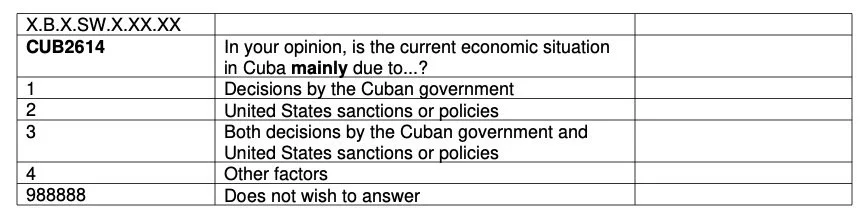
The second question was left out of the Pulse of Democracy report. Instead, the report’s Cuba chapter leads with the heading “Blame Attribution Is Directed at the Cuban Regime, Not the U.S.,” citing the 74% figure.
Julia Jordan, Vanderbilt’s spokesperson, told Belly of the Beast and Drop Site the findings should be interpreted together.
Asked why the second question was not included in the report, she said the Cuba chapter presents only a “small number” of results and that the public data “allow researchers and journalists to examine additional questions.”
It’s not clear that any did. Media outlets and foreign policy journals covering the poll cited only the first question.
Polling experts questioned the survey’s methodology and how the results were presented.
“A question that forces a single choice and one that allows shared responsibility captures different things,” said Mariano Torcal, deputy director of the Research and Expertise Center for Survey Methodology (RECSM) in Barcelona, Spain. “Readers are better served by seeing both [questions] and understanding how each was asked.”
Stanford professor Jon Krosnick, who specializes in studying survey methodology, found flaws in both questions—one failed to define the crisis; the other steered people toward a narrow set of explanations.
“Honestly, I wouldn’t put much stock in either one,” he said.
A Nationally Representative Poll?
The Pulse of Democracy report describes the poll as “a rare window into how Cubans understand the country’s current crisis, who they hold responsible, and what they see as the country’s most urgent priorities.”
The report omitted a key detail disclosed in LAPOP’s technical documentation: respondents were drawn from a pool of CubaData users who had registered through the Apretaste app. The app can be downloaded on Android devices, but iPhone users must use a VPN to access it; Apple’s app store geoblocks users physically located in Cuba to avoid violating U.S. sanctions. Apretaste is not widely known on the island—Belly of the Beast and Drop Site asked more than three dozen Cubans if they had heard of it and only one said they had (although they had not downloaded or used it).
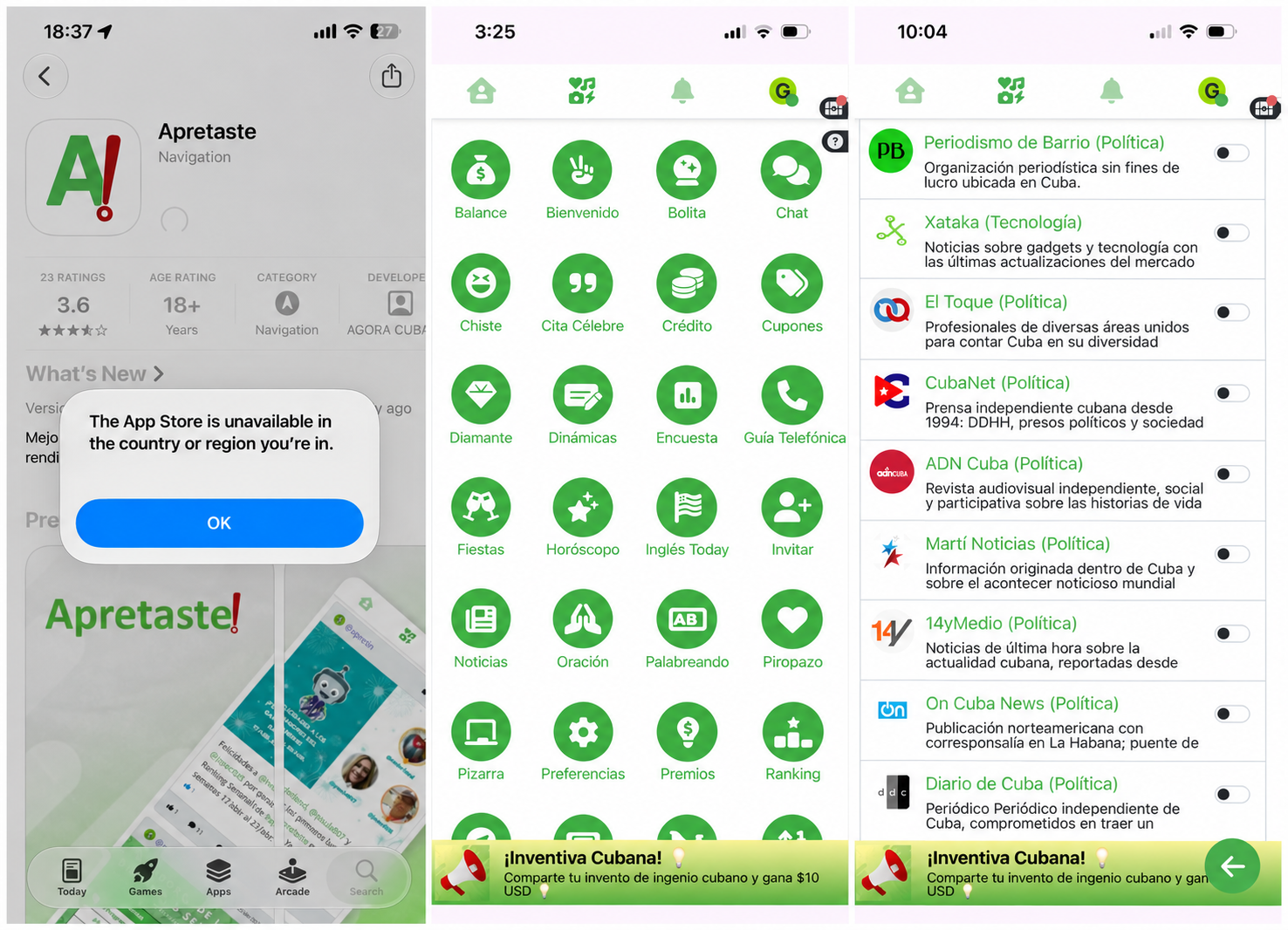
Screenshots of the Apretaste app.
The app offers a kitchen sink of features, including daily prayers and jokes, a dating service, and news (most of the featured media outlets are openly opposed to the Cuban government, and several are U.S.-government funded).
Apretaste also offers a chance to win cash prizes in raffles by participating in surveys. We entered false information about our age, marital status, race, and education level in the most recent survey—about the importance of pets in everyday life. There was no process to verify our identity.
Vanderbilt spokesperson Julia Jordan said CubaData screened for bots or “heavy multi-device usage” and its “communication and data transfer are protected by advanced encryption.” She did not respond to questions about how respondents’ age and residence were verified or whether duplicate submissions could be identified.
In exchange for completing the survey, we received virtual credits usable for raffle entries. Winnings accumulate in a separate dollar-denominated balance. Apretaste says users can claim their prizes as mobile phone credit with Cubacel, Cuba’s state-owned mobile service, or as USDT, a cryptocurrency pegged to the U.S. dollar, once they reach its minimum payout threshold.
The app displayed more than 100 users who had won raffles for participating in the AmericasBarometer survey. Each user’s profile and information—including name, age, race and city of residence—was visible.
Vanderbilt has touted the poll, which it says collected responses from 1,095 adults living in Cuba, as “the first-ever nationally representative study” of Cuba.
The report itself contradicts this claim, acknowledging the survey was not nationally representative because it was based on an online panel that skewed younger, more urban, and more connected to the internet.
According to Jordan “political and security restrictions” prevented researchers from randomly selecting respondents from Cuba’s population.
She did not respond to questions about why a poll that was not nationally representative was promoted as if it were.
“The researchers can claim that they collected data from a specific number of Cubans, but they should not claim that the sample is nationally representative,” said Krosnick. “Simply stating that there is no other way to conduct a survey in Cuba is not an excuse for the use of misleading language that cultivates the impression that the survey is more rigorous and valuable than it is.”
What Cubans Think Other Cubans Think
One of the report’s featured findings states that “opposition to U.S. military intervention appears limited.”
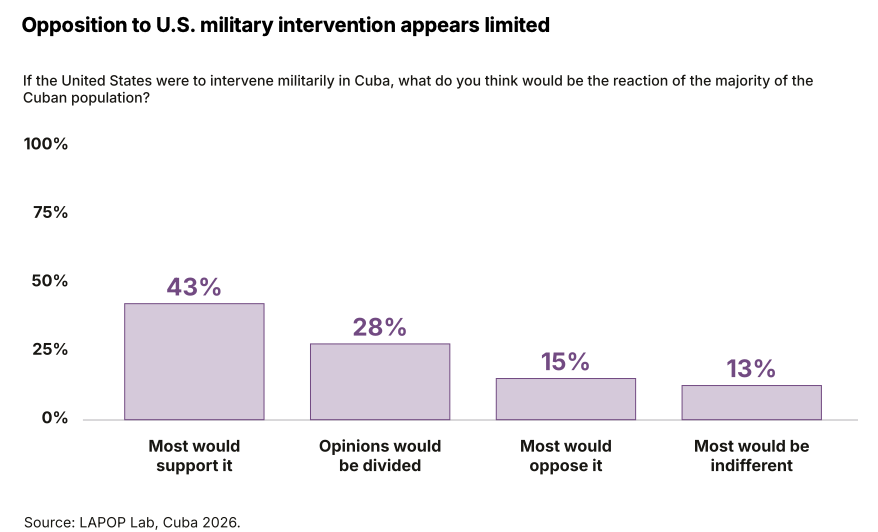
A chart showing how survey respondents answered a question about what they think other Cubans think about a U.S. military intervention. Source: LAPOP Lab, The 2026 Pulse of Democracy.
Unlike the other 72 questions in the poll, which asked respondents their opinion, this question asked people what they thought other Cubans’ opinions were.
Forty-three percent answered that they believed most Cubans would support an intervention. No question asked whether the respondents themselves would support an intervention.
According to Jordan, the question was framed in this way due to Cuba’s “politically sensitive environment…where respondents may be reluctant to disclose their personal views on controversial political questions.”
However, the survey asked other seemingly controversial questions directly, such as whether respondents had confidence in Cuba’s president and whether they believed the country should be annexed by the United States.
Krosnick questioned the value of asking people what they think about what other people think.
“Answers should not be viewed as correctly indicating how other people would feel or as correctly indicating how the respondent would feel,” he said.
Jordan agreed.
“The results should not be interpreted as a direct measure of personal support for military intervention,” she wrote in an email response. “Nor should we assume that respondents can accurately predict how other Cubans would react.”
Jordan declined to answer why this disclaimer was not included in the Pulse of Democracy report or in any of Vanderbilt’s promotional language.
A Long History of Shaping Public Opinion in Cuba
Despite the questions surrounding the LAPOP poll, its finding that many Cubans blame their government for the country's crisis will come as no surprise to anyone who spends time on the island.
Cuba’s economy has been in free fall for eight years as “maximum pressure” sanctions have scared off foreign trade, investment, and credit while decimating the state’s ability to provide basic social services that were long taken for granted. Since January, Trump’s oil blockade and punishing secondary sanctions are plunging the country into a crisis that UN experts have called a “silent Gaza.”
But sanctions are an abstract concept. On the ground in Cuba, people can’t see executive orders and Treasury Department regulations—only their effects.
Turning hardship into anger directed at the Cuban government was precisely what State Department official Lester Mallory proposed in an April 1960 memo that argued for economic warfare on Cuba less than two years before the embargo was imposed by John F. Kennedy.
Mallory called for denying Cuba money and supplies to drive down wages, cause hunger, and desperation, and bring about the government’s overthrow. “The only foreseeable means of alienating internal support,” Mallory wrote, was “through disenchantment and disaffection based on economic dissatisfaction and hardship.”
U.S. efforts to destroy Cuba’s economy, he wrote, should be “as adroit and inconspicuous as possible.”
Sixty-six years later, Mallory’s strategy is in full display.
As the U.S. government systematically cuts Cuba off from the rest of the world, it also discreetly funnels millions of dollars a year to organizations whose mission is to convince people both on and off the island that the Cuban government is solely to blame for the country’s economic crisis.
The recipients of those funds include media outlets aimed at a Cuban audience, such as Diario de Cuba, that report on the country without mentioning U.S. sanctions or their impact.
One question the LAPOP poll did not ask: Where do Cubans receive news and information about the causes of the crisis they are enduring?
If it had, the answers might have revealed that the same organizations and individuals measuring public opinion in Cuba were also shaping it.
Belly of the Beast journalist Charlie Cabrera took to the streets of Havana to ask Cubans directly what they think about potential U.S. military intervention.