
Trump Seizes Venezuelan Oil Tanker En Route to Cuba
The Trump administration on Wednesday commandeered a Venezuelan oil tanker reportedly headed to Cuba, escalating its regime change efforts against both Caracas and Havana.
U.S. Attorney General Pam Bondi posted on X that the vessel was captured “off the coast of Venezuela” by the Department of War, the FBI, the Department of Homeland Security and the U.S. Coast Guard. The operation, she wrote, was aimed to disrupt “an illicit oil shipping network supporting foreign terrorist organizations.”
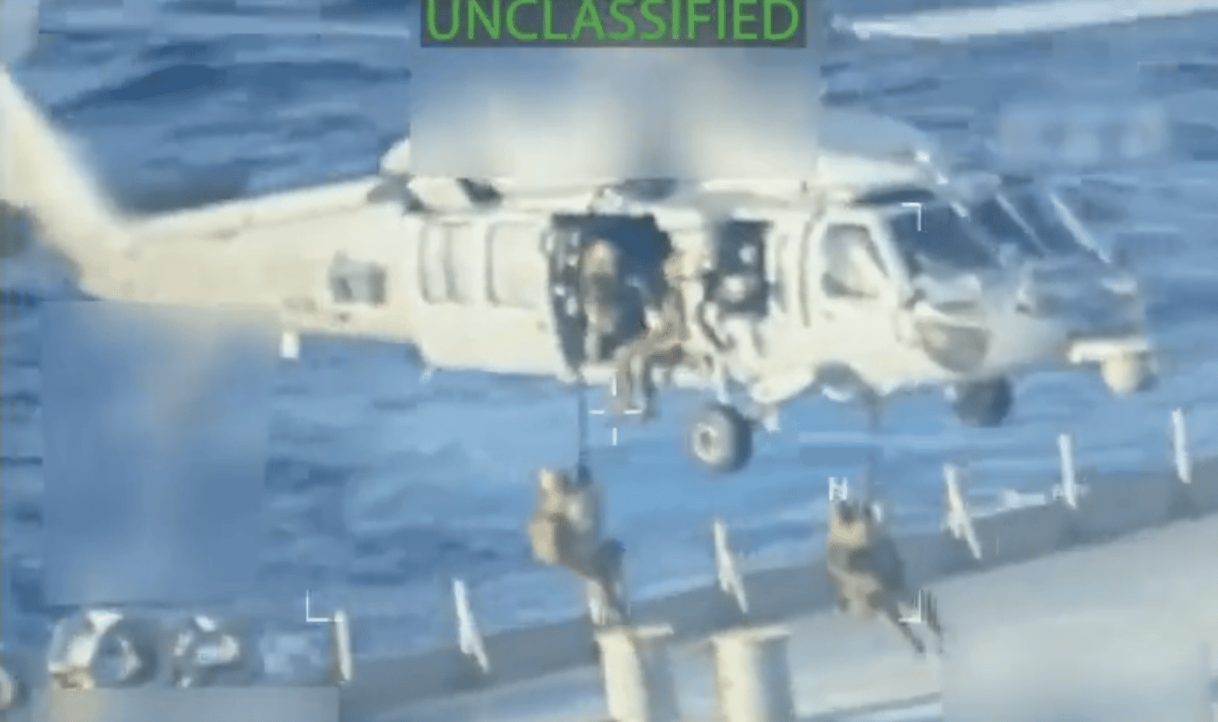
Video of soldiers boarding the tanker from helicopters, posted by U.S. Attorney General Pam Bondi.
Asked what would happen to the oil, Trump said, “We keep it, I guess.”
Venezuelan President Nicolás Maduro yesterday accused Trump of ushering in a new “era of criminal naval piracy.” Cuba has likewise described the move as “an act of piracy” in breach of international law.
Sanctions at sea: the escalating oil war
The U.S. pressure campaign includes doubling the bounty on Maduro’s head to $50 million, authorizing the CIA to conduct covert operations inside the country, deploying more military assets to the Caribbean than at any time since the 1962 Cuban Missile Crisis, and expanding “maximum pressure” sanctions aimed at both Venezuela and Cuba.
The Department of Treasury yesterday hit six crude oil supertankers and the shipping companies linked to them with sanctions. The tankers recently loaded crude oil in Venezuela, according to reports. The Department of Treasury alleges they are “engaged in deceptive and unsafe shipping practices and continue to provide financial resources that fuel Maduro’s corrupt narco-terrorist regime.”
The U.S. has been sanctioning tankers delivering petroleum from Venezuela to Cuba since 2019.
Check out Episode 2 of our award-winning documentary series The War on Cuba, which reports on the impact of the U.S.-imposed “oil blockade.”
An investigation last year by Wired found that in addition to sanctions, the first Trump administration explored clandestinely sabotaging oil deliveries to “strike a blow against both regimes.” To this end, senior officials met with paramilitary experts. One option involved “a mobile system that could covertly (and nonviolently) disable ships.” After CIA pushback, the idea was reportedly shelved.
The seized oil tanker may not have been destined to directly meet Cuba’s energy needs. Politico cited an anonymous White House source who said that the oil was bound for Cuba, where a state-run company called Cubametales was planning to sell it on to energy brokers in Asia.
Still, the seizure is ominous for 10 million Cubans already suffering daily blackouts.
Cuba has relied heavily on Venezuelan oil since the 2000s, though imports have fallen in recent years as both countries have been beset by punishing U.S. sanctions. In 2013, Caracas sent Havana almost 100,000 barrels per day; this year Havana has received a daily average of just under 30,000 barrels per day.
On Friday, the Cuban Ministry of Foreign Affairs released a statement denouncing the “economic war” on Cuba and Venezuela: The action will have "a direct impact on the national energy system and, consequently, on the daily lives of the Cuban people.”
U.S. drug crisis has little to do with Venezuela – and nothing to do with Cuba
U.S. officials justify regime change efforts against Venezuela as necessary to protect the U.S. border from drug trafficking. But Venezuela isn’t a major producer of either cocaine or fentanyl, according to the U.S. Drug Enforcement Agency.
As for Cuba, there is no evidence of drugs flowing from the island to the United States.
The U.S. State Department’s 2024 International Narcotics Control Strategy Report states: “Cuba is not a major consumer, producer, or transshipment point for illicit drugs. Cuba’s domestic production and consumption of illicit drugs are low due to strict policing and stiff prison sentences. Nationwide prevention and information campaigns also deter drug use and sale.”
Cuban authorities allege the trafficking problem, in fact, runs in the opposite direction.
“The country that sends the most drugs into our national territory – specifically synthetic cannabinoids – is the United States,” according to Colonel Juan Carlos Poey, head of the Interior Ministry’s anti-drug unit. Cuba does not “produce, store or allow for the transit” of illicit drugs, he told reporters last week.
He added that authorities have intercepted 14 boats carrying drugs this year and detained 39 narco traffickers with no casualties. But he lamented that despite a 2016 counternarcotics agreement between the two countries, Washington’s cooperation on counternarcotics has been “sporadic,” leaving the island vulnerable to traffickers. “Cuba,” he added, “remains open to collaboration with the U.S.”
Fighting “narco-terrorism” Trump-Style: boosting narcos and sowing terror
The Trump administration’s war on “narco-terrorism” goes well beyond hypocrisy. It’s a show of brute force built on fabrications, state violence, and rewards for drug traffickers.
The administration accuses Nicolás Maduro of leading the so-called Cartel de los Soles. But many analysts say the organization “doesn’t exist.”
Meanwhile, the administration has murdered 87 people at sea since September, without providing evidence any were involved in drug trafficking. Defense Secretary Pete Hegseth reportedly issued a verbal order to “kill everybody,” including shipwrecked survivors – a command legal analysts warn could constitute a war crime.
Most brazenly, President Trump last week pardoned former Honduran President Juan Orlando Hernández – who was sentenced last year in federal court to 45 years in prison for trafficking hundreds of tons of cocaine into the United States. Hernandez accepted a $1 million bribe from Joaquín “El Chapo” Guzmán, one of the world’s most notorious drug lords, when he was running for president. As president, he told a major Honduran cocaine trafficker he would “stuff the drugs right up the noses of the gringos,” according to the U.S. Department of Justice.