
Miami Herald Funds Dodgy, War-Mongering Poll
April 20, 2026
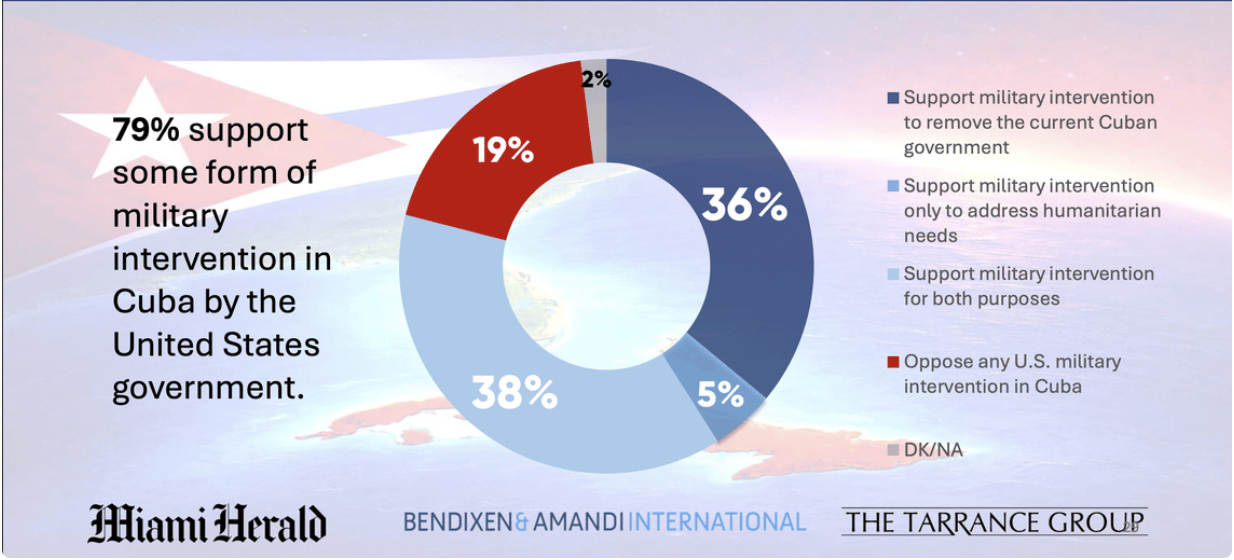
With Trump repeatedly threatening military action against Cuba, the Miami Herald has published a poll that claims most Cuban Americans in South Florida support a U.S. attack on the island.
The telephone poll, commissioned by the Herald and carried out by Bendixen & Amandi International and The Tarrance Group, reportedly surveyed 800 randomly selected Cubans and Cuban Americans living in South Florida.
“What the community is saying here is they’re giving a green light to the Trump administration to go in militarily in Cuba and do whatever it is that they have to do to remove the regime,” pollster Fernand Amandi told the Herald.
The poll and the accompanying article serve to bolster the Trump administration’s case for regime change in Cuba, which Trump has justified by pointing to his support among Cuban Americans in South Florida.
“We have a lot of great Cuban Americans, all of whom just about voted for me,” said Trump on Monday. “Cuba’s a failing nation, and we’re going to do this.”
While Trump won most of the Cuban-American vote in Florida in the 2024 election, there is no evidence they voted for him so he would carry out regime change in Cuba. On the contrary, a Florida International University (FIU) poll that year found that policies toward Cuba were relatively unimportant to Cuban Americans in South Florida — behind the economy, health care and immigration. Even policies toward Russia and China ranked as more important to Cuban Americans than policies toward Cuba.
The Herald article neglects to provide this context and does not mention the FIU poll.
Leading questions, predictable answers
The poll’s question that gave the Herald its headline — “Cuban Americans support U.S. military attack on Cuba” — offered four possible answers, the first three of which endorse military intervention. Respondents were asked whether they support military intervention to remove the current Cuban government, support military intervention only to address humanitarian needs, or support military intervention for both purposes. Only then were they asked if they opposed U.S. military intervention in Cuba. Answers to the first three questions totaled 79% of respondents.
Two of the four questions ask respondents to make the far-fetched, unexplained assumption that U.S. military action, despite the likelihood of violence and civilian casualties, could produce humanitarian benefits. Even more problematic is what is missing from the questions: the U.S. has played a central role in producing the very humanitarian crisis it would ostensibly seek to resolve through military action.
“Brilliant analysis! ‘Military intervention without bloodshed,'” wrote Joe Garcia, a former Democratic member of Congress and onetime executive director of the Cuban American National Foundation, in a sarcastic post on X.
“Designed to manufacture consent”
The poll also found that 73% of respondents believed the Cuban government was to blame for the humanitarian and economic crisis in Cuba — an unsurprising result given that the Herald, along with almost every other media outlet in South Florida, has steered clear of reporting on the impact of U.S. sanctions on the Cuban people.
In addition, the poll found that respondents were split on whether the Trump administration should negotiate directly with members of the “current communist leadership or political establishment.” It’s not clear with whom else the U.S. would negotiate.
Cuban Americans for Cuba, an organization that advocates for ending the embargo, said the poll was “designed to manufacture consent for military invasion, not to understand what our community actually thinks.” Check out their post HERE.
The group questioned why Cuban Americans living outside of South Florida were not polled.
“A poll of Marco Rubio’s backyard is not a mandate from 2.5 million Cuban Americans,” according to the group.
The Herald did not explain why the poll didn’t extend beyond South Florida, although in an editorial about its findings, the newspaper’s editorial board acknowledged that “it’s very likely that the results of this poll differ greatly from how other groups of people in South Florida, and Americans in general, feel about tactics in Cuba.”
The editorial also conceded that "opinion polls shouldn’t dictate American foreign policy." And yet the editorial’s headline — “South Florida’s Cubans made their wishes clear and that must weigh heavily on Rubio” — appears designed to pressure Rubio (and Trump) away from any deal with Cuba and toward a more aggressive stance.
Given the poll’s leading questions and flawed methodology, it’s not at all clear the results should weigh heavily on anyone.
The poll itself shows that as many Cuban Americans favor negotiations with Cuban leadership as oppose them — a finding the Herald’s editorial glosses over. Moreover, the entire poll was not published, so readers are left with what is presumably a curated version of the findings.
Meanwhile, neither the poll nor the Herald's article and editorial reflect the complexity of viewpoints about Cuba policy held by many Cuban Americans and the seemingly contradictory responses depending on what question they are asked (or how it is asked). For example, in the 2024 FIU poll, most Cuban Americans said they supported the continuation of the embargo, but most also said they supported allowing for “unrestricted” food and medicine exports to Cuba.