Gloria Caballero’s Clear Position on Cuba: “Sanctions Hit Black Cubans Hardest”
May 18, 2026
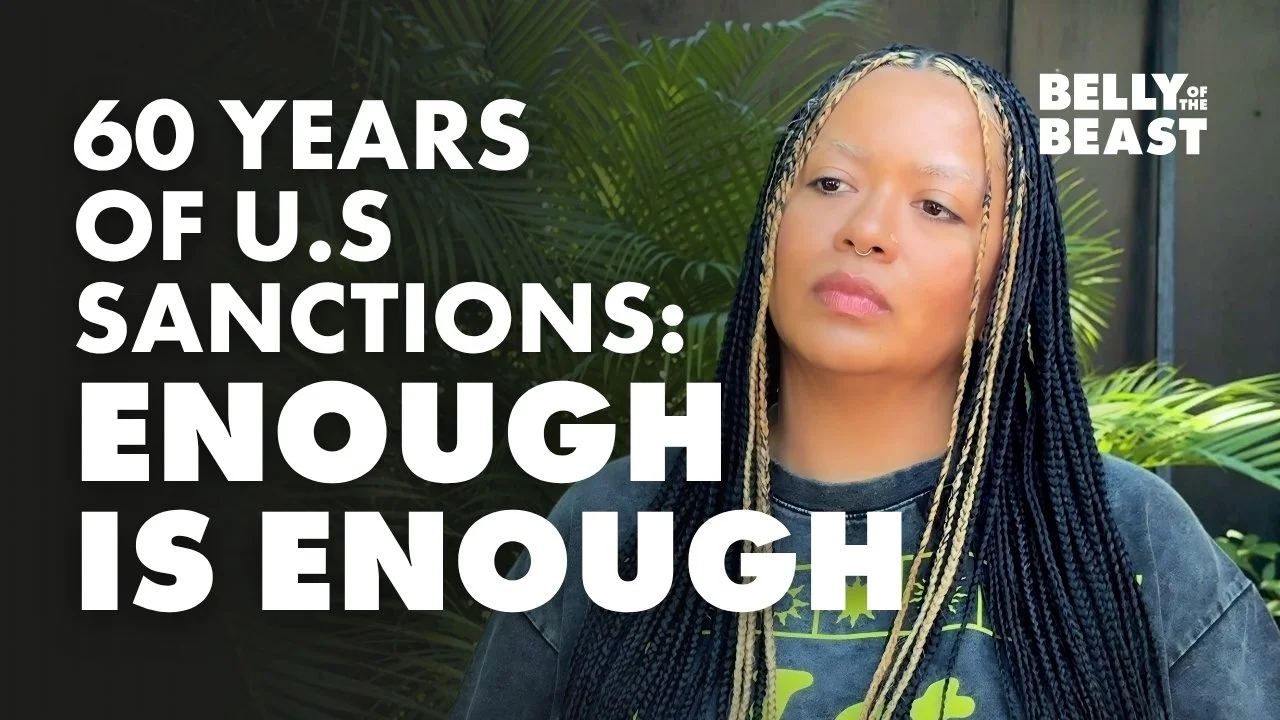
Dr. Gloria Caballero Roque grew up in a single room in Old Havana with four siblings, no running water, and a mother who sold things on the street to feed them. Free education, universal healthcare and also a strong mother who pushed through, she says, are the reasons she made it to university. She went on to earn two PhDs, teach for 35 years and run for political office in Holyoke, Massachusetts.
In this interview she speaks about her childhood, her transition to life in the United States and U.S.–Cuba relations.
She says Cuban-American politicians like Marco Rubio pushing for harder sanctions do not speak on her behalf. Their hostility toward Cuba, she argues, comes from people who can't accept losing control of the island. "They have become monsters against their own people," she says.
Discussing what's happening inside Cuba without discussing the blockade, she says, is treating the symptom while ignoring the disease. "Close the door of this house for 60 years and let's see how you survive."
She says sanctions hit Black Cubans hardest, a legacy of colonialism. The blockade reinforces a structure that was already there.
Related Stories
U.S. Lawmakers: Sanctions Are “Like Dropping Bombs”
Share this Report
-
"Hi everyone. Welcome to Belly of the Beast. My name is Liz Oliva Fernández, and today we are going to be speaking with Gloria Caballero. Gloria, welcome to Belly of the Beast," said Liz Oliva Fernández, journalist with Belly of the Beast.
"Thank you so much," said Gloria Caballero Roque, Cuban-American educator and activist.
"Thank you for accepting the invitation, Gloria. Gloria, could you introduce yourself? Please," Oliva Fernández said.
"I was born in Cuba, Santiago de Cuba, from a mom that had four children. I was raised by my mom. I moved from Santiago to Havana when I was three years old. It was in the 70s and we were squatters for a year in Marianao. After that year, the government gave us a room at Hotel Monserrate in Old Havana Village. In that room, four siblings. My son was born there. I was a single mom by 19 while I was going to the university," Caballero said.
"I graduated in Cuba as a translator and interpreter at ISPLE (Higher Institute for Foreign Languages) at the time. It's a five-year career, and I worked there teaching English for seven years before marrying my current husband, and after that, I moved in 1997 to the United States, always here in the state of Massachusetts," she continued.
"I worked two years in Milton Academy and we moved out west where I did my first PhD at the University of Massachusetts here in Amherst in Latin American and Portuguese Literatures," the educator added.
"I am currently directing an after-school program in my city, supporting children from first grade through fifth grade doing their homework and supporting them with their math, reading skills, and reading comprehension skills," Caballero said.
"I was always a professor, teaching for 35 years at college and university. I taught literature, African studies, Latin American studies. I taught gender and diversity studies," she said.
"After 35 years, I decided to change careers. I ran in the city of Holyoke for mayor in 2001 and then I ran for state auditor in the next year, 2002. Then I ran for school committee and finally I got elected in that position here in the city of Holyoke, which I had to resign due to a conflict of interest with this new job that I accepted, working with families and schools, etc.," Caballero added.
"How was your childhood and where did you grow up?" Oliva Fernández asked.
"I'm coming from a very humble family in Santiago de Cuba. My father was one of those 'hombre nuevo,' the new man, cutting sugarcane, doing a lot of shifts, guarding sugarcane fields, etc. He devoted a lot of time doing that while mom was already 21 years old, raising four children," the activist said.
"That's why my mom moved to Havana by herself with her children. We were always very poor. Imagine squatting in a place that used to be a cold chamber for a year," she said.
"So growing up in Old Havana was always very hard. No sanitation, no running water, selling a lot of stuff on the streets, because mom was a single mom. Sometimes there was lunch, sometimes there wasn't," Caballero continued.
"Thank God for the fact that we had free education through college and free health, public health and universal health care, it was free, because otherwise, living here in bad conditions, that economic class would never survive," she said.
"A woman with four siblings, Black, and no universal health care, no universal education for their children. My mom made that commitment to her children. They will have all to go to college. She made her effort and did a lot to put the four of us through college," Caballero added.
"When did you move to the United States and why did you decide to move to the United States?" the journalist asked.
"In 1989, they left me to teach at the same university that I graduated, ISPLE Pablo Lafargue. So I taught there since 1996-7. I met my husband in 1994, and he was one of the professors coming from Canada to give Cuban English teachers at that university and different universities throughout the country to teach courses in methodology, translation, interpretation, you name it, and they would bring a lot of resources to Cuba, so I met him in 1994," Caballero said.
"We married in 1995. Our son was born in Cuba in 1996. He's 28 years old. I never imagined abandoning my family, never, and I am the only one from my family living outside of Cuba," she added.
"I want to ask, when you started working as an interpreter, your life changed?" Oliva Fernández asked.
"I was the interpreter of people that were the presidents of oil companies in Trinidad and Tobago, in Guyana, going to all these hotels, that pompous life," Caballero said.
"So, yes, my life changed, and then going back to my reality as a teacher without an alarm clock in my house, living still in that same hotel because I was given one room apart from my mom's room. It's just proof that change is transitional momentarily. You move into a different world, different dimensions inside the same space, which is Havana," she said.
"And my life changed when I came, psychologically, because I missed my family, and I had to face a different culture, language, temperature, foods, urban layouts, etc. But it also changed economically in that I'm able to send some help, some aid to my family in Havana," Caballero continued.
"And I was the youngest, and I had to teach them to learn a new language, a new foreign language," she added.
"What was your first impression of the United States?" the journalist asked.
"The waste, the throwaway," Caballero said.
"It was so easy to find piles and piles in '97 of clothes, food just being thrown away, furniture, appliances, people moving out, college students ending the academic year, everything was put on the streets. And then me looking at it, you know, in awe because the furniture that we had in Havana, we made it with my mom. My mom and us, her children, we made chairs, we made the armchair," she said.
"What made you decide to go into politics, Gloria?" Oliva Fernández asked.
"I wanted to also explore the possibility of just, how can I say that what we're doing in this country is criminal? How can I say, or where can I say that me having two PhDs, two master's degrees is struggling to get into a position of decision making when there are people who don't have the qualification and yet they have learned and are being opened and welcome to get there? Where is the failure? Where is the link? How can I grow and learn while at the same time motivate others to speak up?" Caballero said.
"And for all of the above, I also say, well, how about U.S. bilateral relations with my country? Why is it that people are not accepting that we're suffering also, not only for all the problems that we have internally, which we do, but also if we take a zoom look at the situation, we're not talking and being serious about the embargo. I know there's corruption, I know there's mismanagement, I know there's so much that needs to be done, I know that," she continued.
"But I challenge people and say, close the door of this house for 60 years and let's see how you survive," Caballero said.
"I also got involved because I see a lot of underinvestment in schools here in my community and in many rural communities. I see homelessness, I see people suffering from mental health and just can't handle it," she added.
"I see a lot of youth without programs once they leave the school, what's for them after school? I see mothers that are single parents struggling to get a child care facility for their children so that she can go back to school, get a decent job, etc. I wanted to say that, hey, why is it that you're not investing? How come the people elected are the same people? How come you're not registered to vote? How come you don't talk to or believe in your local government? How come you're not getting more involved?" the activist said.
"I think we all, if you come from a family that had to struggle in Cuba and really had faith in the revolution, you are political because once you leave your country, you see how many injustices are out there having all the resources and infrastructure. You say, how come you're not solving this problem? Why is it? Well, we don't have what you have and we're able to solve so many of our problems," Caballero said.
"What is the major challenge that you have to overcome in your political career?" the journalist asked.
"I mean, here everything is about money when you enter into this field of politics, money and name recognition," Caballero said.
"I belong to a third party, the Green Rainbow Party Coalition. So, it's not a major party. It's not the ones getting all the donors, you know, money from donors and billionaires and AIPACs, etc. So, that's a challenge," she added.
"You already talk about how the U.S. policy on Cuba, in some part, influence you to want to be part of politics itself. But what is your stance on the policies of the Cuban Americans in Congress right now are pushing towards Cuba?" Oliva Fernández asked.
"I think they forget that as humans, we have the right, and as a sovereign country, we have the right to just design our own project. That's number one. Number two, they don't speak on behalf of all Cuban Americans," Caballero said.
"They don't speak on my behalf, or of the three other Cubans that I know here. It's sad to see how people can cheer around death and destruction. It is so sad to see people who, whose parents were born in that country, you see that they have been, that they have inherited that hate," she continued.
"I will pray for them, because they have become monsters against their own people, against sacred creations. And that is not right. We are a sovereign country, and they should respect that," Caballero said.
"If you don't like that project, forget about it. Move on. The Rubios and the other ones, they can't forgive not being the owners of that small island, and not being able to just carry on with their mafia, with all the legal prostitution, with the concentration camps of peasants in the countryside, which happened in our country," she added.
"One of the sectors of the population most affected by U.S. sanctions on Cuba are Black Cubans. What role does race play in the making of U.S. policy toward Cuba?" the journalist asked.
"I've been telling my relatives, my family, if you take a look at Cuba and look at the areas where the worst living conditions are, where worse accessibility to resources and transportation are, is mostly inhabited by people who are Black," Caballero said.
"If you don't meet their needs, if you don't invest in that infrastructure, it's easy for an NGO to say, Ok, I'm going to pay you the phone bill if you go and tell your neighbor to go out and make some noise. And they know it here," she said.
"So whatever is done that is thought of to affect the entire system or the island is going to bear even heavier weight on the communities of color, as we call it, no, on Blacks, mostly, and poor people. You see?" Caballero continued.
"So it also has a lot to do with representation and how you internalize and naturalize that lower class citizen. That when these politics outside affect the country, it affects more the people who already are suffering inside the island for centuries because we're talking about since colonial period," she said.
"So it transcends the embargo in that it comes from the colonial period, but then it gets reinforced with the embargo because the Black people are the ones that are bearing the brunt, the heavier brunt," Caballero added.
"Sometimes it's difficult because when you talk with the Cuban Americans who live in the United States, who have been like involved with the propaganda, because we talk about Cuban propaganda, but let's talk about U.S. propaganda," Oliva Fernández said.
"That's better for me and works so much better. You can see when you talk to the people here, they say like: 'okay, forget about the sanctions. Let's talk about the problems that we have inside of Cuba.' Do you think that that's possible?" she asked.
"That is such a recurrent equation that people propose. Forget about it. Let's talk about what's happening inside," Caballero said.
"If you just talk about what's happening inside, you're talking about the effect. You're not talking about the causes. If you want to cure a disease, you want to prevent it and you want to do research, all the scientific resources that you had to prevent that disease and find the root cause of the problem," she continued.
"So it's just putting band-aids in it. The problem is going to go back and continue. You cannot distance, you cannot separate one from the other," Caballero said.
"Because in physics, we talk about cause and effect and time-space. You can't. What is causing is an inheritance of colonial imperialism that still subsists in our country, under the basis of these new geopolitics, one in which the imperial politics and strength of a nation, which is the most powerful on earth, has always wanted to expand their tentacles through wars, through sanctions, through blockades and embargo, through coup d'état," she added.
"Cuba has to be prepared, you see. They have to be ready. Be ready for the policies and we have to be louder out there so the rest of the world knows what's going on, what's going to come down to the country," Caballero said.
"We need to keep building allies with the rest of the world as we have been doing, international cooperation and collaboration and really standing up every day at the UN and denouncing all these policies every day. We should not rest. We should keep making aware the rest of the world about these criminal intentions," she continued.
"Biden put more sanctions on top of that and now we have a person who's a Cuban-American destined to really put forth and materialize his project that is criminal," Caballero said.
"We are a sovereign country, we can talk, we can get to agreements and that's what should bring, as they say, peace and freedom. Now then, let's talk, let's negotiate, let's use diplomacy," she added.
"In your opinion, what should U.S. policy toward Cuba be like?" the journalist asked.
"Come on, we're 90 miles away only. You know? We should be neighbors, good neighbors or at least peaceful neighbors," Caballero said.
"There's so much that Cuba can contribute to this country in terms of wisdom, you know, in terms of the arts, in terms of science, in terms of so much. They talk about the world, the environment, I should say: Talk to a Cuban. They talk about innovation...talk to a Cuban. They talk about love...talk to a Cuban. They talk about culture...talk to a Cuban. We are close, we are as human as you are, but when you want to conquer a people, you have to dehumanize them and that's what's happening with us. But, oh my god, it's easy," she said.
"The minute Obama softened a little bit the borders, I mean the relationship with Cuba, we were happier people, the Americans were happier to go and visit, and just tour and being curious about these new people. We are close, so the relationship should be that of cordiality, you know, and respect. We're just 11 million people and they're here hundreds of millions," Caballero said.
"We're not a threat, we want to be good neighbors and we want respect the same way you want respect. It's easier to be friendly and peaceful than to work hard and create a lot of policies to really become evil. So, which one? I really go for the easiest one," she added.
"Let's talk," Caballero concluded.
"What's your relationship with Cuba right now? What does Cuba mean to you?" Oliva Fernández asked.
"What's my relationship with my country? I love my country, that's where I was born. Do I get mad? Yes. Do I get frustrated? Of course. Would I wish things changed internally? Yes. Do I have the ability to make that happen? No, but that frustrates me," Caballero said.
"Of course, there's this other side in which, a little bit of dollars makes a difference. You buy and you alleviate for a little bit, but it's nothing that I have been able to get out of my heart, which is the struggle with which I was always surrounded by since I was a child, and I'm used to it, that's given me strength to live in this country, has given me the resilience to stay in this country, and that experience, although it was really hard, has given me the opportunity to tell that story to many people here, and so that they understand that they have it all and that they can do better," she said.
"So that's my relationship. It's a tool also. It's love and it's everything, it's everything," Caballero concluded.
Support Independent Journalism from Cuba