Dr. Teresita’s Quest to Help Her Mother Through Alzheimer’s
May 14, 2026
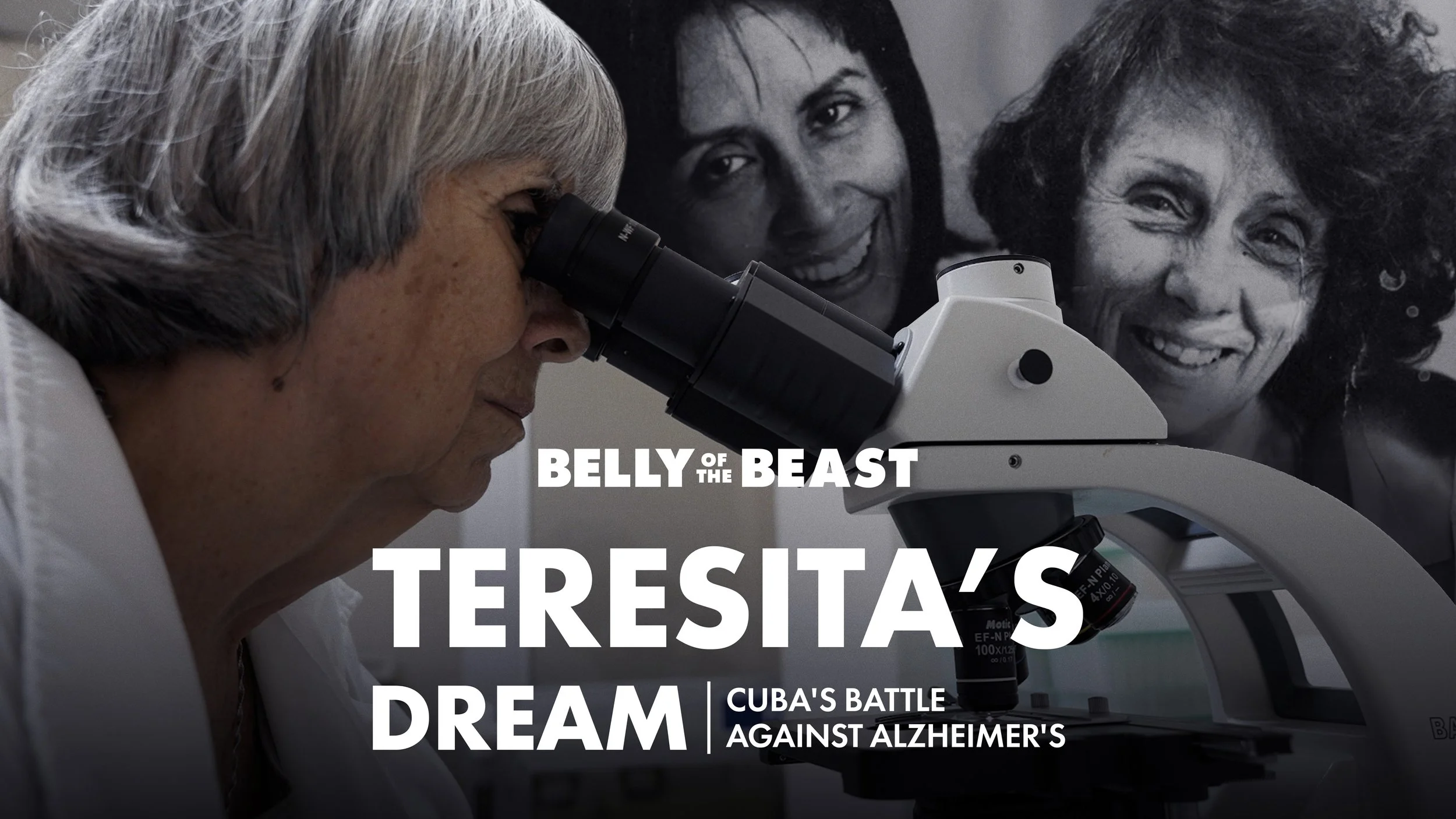
When her mother was diagnosed with Alzheimer’s, Cuban scientist Teresita Rodríguez was distraught. Her mother was her role model, her hero…so she set out to find a way to help her. At the time, her colleagues at Cuba’s Center for Molecular Immunology were working on a new drug, and Teresita joined them in their research.
She soon realized the medication could actually help her mother, so she started giving it to her. Teresita eventually became the leader of that team, and the results she witnessed with her mother became the inspiration for a medication that could be a game changer for Alzheimer’s treatment worldwide.
Set in the heart of Havana against the backdrop of Cuba’s world-class biotech sector and the relentless challenges posed by intensifying U.S. sanctions, Teresita’s Dream is a powerful story of scientific innovation, love, hope and resilience.
Related Stories
Share this Report
-
In 2012, I learned that CIM was developing a product with neuroprotective properties. They called it NeuroEPO. What I wanted was to find a medication that could help my mother with her dementia.
I approached Daniel Almaguer, who at the time was managing the project, and I told him, “I want to work on this project.” In 2013, I officially joined the team.
At first, the medication had been intended for another condition, for example spinocerebellar ataxia. I began studying the molecule itself — NeuroEPO. I started researching its characteristics and how it affected the nervous system. One of the things I wanted to know was whether this molecule could help my mother with her dementia.
That’s when I realized it could potentially have benefits for Alzheimer’s disease.
The risks were so low compared to the possible benefits that it could bring, that I decided to take the chance. Doctors had already told me that my mother’s dementia was very advanced and that NeuroEPO might not do anything.
I gave it to her continuously for about three years.
And then she began showing changes.
She started communicating with her caregiver again.
She no longer forgot how to eat.
I used to have to take my mother to the bank to collect her pension. My mother, who had been a social sciences professor, had reached a point where she had to sign with her fingerprint because she no longer remembered how to write her own signature.
After seeing the results, I took out a notebook and handed her a pen. Intentionally, I told her:
“Mom, sign.”
And she wrote “Amelia.”
It wasn’t her full signature the way she used to write it — it looked more like a scribble — but she wrote Amelia. She understood that signing meant writing her name.
That was the moment I told Daniel:
“This product is for Alzheimer’s.”
Daniel was later assigned to work at the joint venture company in China, where I also spent time, and he asked me to take over management of the project.
On July 8, 2015, my mother passed away.
NeuroEPO helped. But she was already in a very advanced stage of the disease.
Patients in earlier or moderate stages have a much greater chance.
Support Independent Journalism from Cuba